

Hi, I’m Deborah Holdship, Editor of Michigan Today.
It’s been a while since we’ve talked! I retired the Listen in Michigan podcast after 60 episodes, but I’m resurrecting it for this special episode with author John U. Bacon, two-time Michigan graduate, and best-selling author. His new book: The Gales of November: The Untold Story of the Edmund Fitzgerald, is on shelves now, in advance of the 50th anniversary of the tragedy on Lake Superior that virtually every child of the Great Lakes has heard at some point.
Especially those of us of a certain age who may have been fans of CKLW. Mostly because the disaster, which claimed the lives of 29 men on Nov,. 10, 1975, inspired one of the eeriest popular songs in modern history. If you’ve never heard it – or if it’s been decades, since you have — I dare you to search YouTube and listen to Gordon Lightfoot’s “The Wreck of the Edmund Fitzgerald” as soon as you are done listening to this episode.
As kids we were always quick to change the station. The folky dirge is like a ghost story or a horror film. You know the ending. You don’t want to know the ending.. But you DO know it and it never changes, and it’s scary and sad and SO evocative. When Lightfoot, evoking the ship’s old cook sings, “fellas it’s been good to know ya” I LOSE my mind. Just reading the lyrics will bring tears to your eyes.
I listened to it once – and only once — after speaking with John and reading the book. I had chills the entire time. And one reason is that in John’s book he introduces you to those 29 men and you get very attached. He interviewed family members and loved ones and uncovered the most poignant personal gems that humanize this tragedy in a way the melds beautifully with Lightfoot’s musical eulogy.
And there was a method to his madness, John told me. Since we already know the ending of the tale he needs the reader to suspend disbelief, get on board this doomed ship, and invest in these sailors. And pretty soon you’re locked in, and you almost forget the destiny that awaits. Until it happens. Powerful stuff.
OK, I’ll stop talking. Here’s John, ever enthusiastic, reflecting on some of the wild stuff he learned about one of his main characters: the Great Lakes.
John Bacon: I had no idea and would never have guessed that the experienced sailors who’ve done both the Atlantic and the Great Lakes say the Great Lakes are more dangerous. That it’s not even close. And that was just stunning to me. And also the mere fact that between 1875 and 1975, 6,000-10,000 Great Lakes shipwrecks occurred taking down 30,000 men. These are all low estimates. That’s a shipwreck a week for a century. That’s a casualty a day for a century. So yes these Great Lakes are no joke.
Deborah Holdship: Who chooses this as their career like and these people are obviously such interesting characters unto themselves, you know?
JB: And you’re right about that. Who gets on is a guy like Captains McSorley and these other guys born in the 1910s and 1920s. You’ve survived the Great Depression and these are blue-collar families. All of them. Until you get to the deckhands. Young deckhands in the 70s, they grew up grateful for any work they could get, and of course they most of them served in World War II, often with great distinction.
These are guys who are trying to get off the farm or avoid the mines or the factories. And compared to those jobs, being in a freighter after World War II is a very good job, especially with the unions kicking in the 1940s and 50s. The lowest ranking guy on the ship Edmund Fitzgerald, that guy’s making $180,000 in today’s dollars and you’re 20 years old. And you also eat like a king. I’m not saying it’s easy. I’m not saying it’s always fun. It’s dangerous, but compared to the options, it’s pretty good.
And the really hard part, I think. these guys you are gone… I wondered how come I don’t know any sailors, any commercial sailors? Here’s why. Because there’s only 30 per ship and even at the heyday only 300 ships in 1975. That’s 9000 people spread out over eight Great Lakes states: a lot in Duluth, a lot in Toledo, a lot in Cleveland, some in Michigan, of course. But that’s not great ratios. And even if the guy’s living next to you, you wouldn’t meet him because he’s on a ship nine months out of the year. No vacations, no breaks, no weddings, no birthdays. And one of the guys, John Hayes, a proud graduate of the Great Lakes Maritime Academy, he said, “I’ve got three kids. I’m very close to all three. I didn’t teach any of them how to ride a bike.” And that’s got to break your heart.
DH: The thing about these stories is you just wanted to end a different way. It’s compelling and it’s such an adventure story and it’s these guys are so great.
JB: And then you have to care about, you have to know these guys and care about them before that last trip. It can’t just be the end and we tell the story right? In what we call the Tick Tock section, no relation to the website, we have 11 chapters on the last run. All the other sections are four or five chapters. Once you get into the last run, you shouldn’t want to stop. And the details of it, hopefully you keep moving.
The model here is James Cameron’s Titanic, the great movie. I know the ship goes down. I’m pretty sure of that. But you suspend disbelief to think that maybe this time it turns out differently because you care about the people.
DH: Well, and it’s so interesting to hear from the grandchildren or the children of these guys. And their memories of them, there were 29 of them.
JB: These guys are just genuinely good guys and they aren’t on all ships. They’re an unusually happy ship due to an unusually in enlightened Captain.
DH: So talk to me a little bit about McSorley.
JB: He was not a tyrant. Unlike a lot of them at that time, he didn’t yell and scream. Didn’t throw coffee at people, which others did. And there was not the usual division between the engine – it’s like offense and defense on a football team. You got the engine group and the below deck. Of course they handle the engine, all the other mechanics and you got the pilot house group, that’s the captain, first mates and so on. But usually they’re above deck, they’re at the bow in this case. And they almost never get along. These guys got along famously. And that was very good.
There was a generational gap. You had three quarters basically were World War II vets and one quarter were trying to avoid Vietnam. So that’s two very different groups there. And you can see that the haircuts are the brush cuts versus the long hair and the lamb chops. I mean it’s very stereotypical and on most ships that was a problem and on this ship it wasn’t. And the answer to all those things was McSorley. He was very good to everybody on the ship. They all loved him. He had very high standards, but they all said he was utterly fair. If you did your job, he’s got no problem with you. Also, these guys were so loyal to him that they moved from ship to ship whenever he got promoted. One guy, Craig Alquist, who’s on the ship a few months earlier, he had a great line, which I will not use here, this is family programming, but he said, “I’m pretty sure McSorleyy had very strict ‘no jerks’ policy.” He used another word that I will not use here but you get the idea. Patrick Devine, son of a judge in Toledo, a Marquette student, said, “I’ve been on 10 ships, and seen plenty of weirdos.” And this is the 70s, so more weirdos than usual perhaps during that stretch. And he said, “We didn’t have that in the on the Fitz.” These are just generally good guys you wanted to work with. And he said, “It’s very simple. This is the greatest ship in the Great Lakes. This is the greatest captain on the Great Lakes.” And everyone said the same thing. You fight to stay on that ship. And that was that.
The ship when it was built, Edmund Fitzgerald was the CEO of Northwestern Mutual Insurance in Milwaukee. Right now, it’s like a $30-billion company, but his grandfather and six brothers were all Great Lakes captains and that’s a large percentage of what was out there. Just a crazy family. And his Dad was the best shipbuilder in Milwaukee. So he wanted to build one specification: “We’re going to build the greatest ship the Great Lakes has ever seen.” And they did it.
It was the longest and 729 feet. It carried the most cargo. It was one of the fastest. It very quickly broke every record in the Great Lakes and started breaking its own for 13 years nonstop for cargo loads, cargo speed, seasonal hauls, all this stuff. But here’s the catch. It’s 729 feet long. And you, Michiganders, should get this one. That’s one foot shorter than the tallest building in the Renaissance Center. So that’s how long these things are. Yeah, they’re crazy long, but it’s only 75 feet wide. That’s less than the distance from home plate to first base by 15 feet. Like a giraffe’s neck.
Why does this exist? Two reasons: They’re trying to maximize the cargo that they can get through on each trip and you got to squeeze through the Soo locks. The Soo Locks are the bottleneck of the operation. They are very crucial – a 20-foot drop from Lake Superior to Lake Huron. And this ship was within specifications to one foot on both sides so you can maximize that. And there are no ships like this built anywhere else in the world. You don’t make anything that absurdly long, which means, all right, with the waves we’re talking about in the Great Lakes — which are worse in many ways due to lack of salt on the on the ocean. The salt in the waves squeezes down the top of the waves – the top gets shaved off because the salt water packs it down and then it spreads them out. Also the weight of this water on the Great Lakes the waves are pointing like this. So instead of 10 to 16 seconds apart they’re 4 to 8 seconds apart. You can have the bow of this ship on one 30-foot wave and nothing in the middle and your sterns is on top of another 30-foot wave. You’ve got 26,000 tons of taconite in the middle. 26,000 tons of taconite is equivalent to 4200 adult elephants, right? Put your bow on that end and your stern at that end. What’s gonna happen the middle with 4200 hundred adult elephants? The equivalent of enough taconite to build 7000 cars per shipload?
Well, it’s gonna crack. It’s gonna bend back and forth. It’s called sagging like this. And then the next wave, it goes over the wave. It hogs, sags, hogs, sags, hogs. Do that 10,000 times in a day. That’s how many waves you get. You bend a paper clip back and forth like that 10,000 times… What’s going to happen eventually? And again, I had no idea.
So I love it when online before the book came out, you see all these comments: What “new” can we possibly know about this, All of it?
DH: Just with any one story, when you start digging, you start learning stuff. I mean, you got the guy that had the diamond ring that he didn’t take with him on the ship. You got the guy whose girlfriend is pregnant and now the mother has a descendant that she can, you know, substitute for her lost boy. Just the stories are so beautiful.
JB: Working on so many fronts, I got lucky to find six crewmen who were still alive. They’re not making more of those. There might be a few others out there, but boy, I bet not more than two or three because this is 50 years ago. I got families, of course, willing to talk to me. Also this: The stories that I discovered through the families were just incredible. And when you pitch a book proposal in New York to the publishers, you;re basically a geologist promising them, “look, there’s oil down there, I promise.” Then you get a contract and they call your bluff and, “Ohh, crap. I gotta go find the oil.”
But it kept coming, as you can see in the book. It just kept on springing up stories that I never expected. We talked about McSorley. McSorley was going to retire after this run and pay for his wife’s medical care. One more trip for a bonus. He’s gonna retire after this run. And that was because she’s in a healthcare already. We think cancer, but I’m not quite sure. That’s a good guy. He’s not being greedy, he’s not pushing it. He’s a good guy. T
Then you’ve got Bruce Hudson, 23 year old, went to Ohio State, took a year off to get on the ship. Can’t blame him. It’s $180,000 in today’s dollars. And while he’s doing it, he’s got one weakness and that’s his muscle car parked. He and a buddy, Mark Thomas, also from suburban Cleveland, are going to hop in this car in three days. A Burgundy, 1973 Dodge Challenger 72, I think. Sorry. They’re gonna hop in this thing and go West. Back then getting Coors beer in Colorado is exotic.
DH: Oh yeah. Remember that.
JB: And then go to LA and then go back on Route 66. They had it all mapped out. And then he finds out from his girlfriend, Bruce Hudson does, while he’s in a bar in Silver Bay, MN, and his girlfriend in Toledo, Cindy Reynolds is pregnant. So that will change your plans. He says, “don’t worry, we’ll move in together, we’ll waves the child ourselves, we’ll be OK.” She was very relieved about that, as you might imagine. And then she says, ”you know what, go on that trip anyway, because that’s November and the baby’s not due till June. We’ll be OK.” So then he thinks he might be marrying her, so he got the right girl. Of course, this ship goes down and Bruce Hudson’s mother thinks she’s lost her only child. She has. But the she was surprised to learn six months later that she’s going to be a grandmother. She has no idea about this. So heartbreaking in many ways, but also she doted on that kid, Heather, like you can’t believe — took her shopping all the time. And then Heather has four children. One of them, Austin, looks just like. Bruce Hudson, the son that she lost. So guess what? She played favorites with Austin. So that was a bittersweet story.
Then you’ve got Eddie Benton, who you mentioned. He’s 47 years old. He’s about to retire after 25 years on the Great Lakes. He’s had got a Navy pension. Also, he’s got no kids, but a wife of 25 years. There’s a picture of them in the book. The day before they leave on this trip, he gets to port from Superior, WI, which is a port city right next to Duluth. He goes across the border to buy a fancy diamond ring for their 25th anniversary and for reasons, Deb, I have no idea and no one does except for him, he gives it to a friend to mail to his wife instead of just putting in his duffel bag. You’re gonna see her in three days. She’s gonna be at the dock in Toledo’s, gonna pick you up, drive you a couple hours to where they live. And we have no idea why he did this, but a week after the ship went down, she gets a package in the mail and it’s her 25th anniversary ring.
DH: Oh my God. And even just the the irony that Edmund Fitzgerald really did not want them to name this ship after him.
JB: He did not have a great ego. He was really a quite beloved, humble guy. A very successful CEO. They named it after him. He did not want it. So they arranged for him to get out of the room for something, and they named it for him against his back.
DH: They think they’re doing him some honor. And he’s like, no, no.
JB: I mean, he’s in the era where these ships were going down on a regular basis. He e knows the risks. If it goes down, you’re attached to it. Yeah. So his son, also Edmond Bacon Fitzgerald, no relation that I know of, but he’s the owner of the Milwaukee Brewers. He’s the one who brought the Brewers to town. He said the day “the ship was launched on June 23rd, 1958, it was the best day of my dad’s life. The day it went down was the worst.”
DH: Cannot even fathom it. All right, Well, Speaking of the day it went down, the reporting, I loved the excerpt you gave me and the stuff about the reporting and just how just effective and efficient and amazing and accurate this was.
JB: For the time being, as far as the reporting goes, how many guys from ‘75 were at all involved in the story are still around? It turns out that Harry Atkins, the guy who did the Associated Press story at the time, he’s in his 80s. He’s a friend of mine from the press box at University of Michigan. He was the AP reporter for sports for the state of Michigan for decades. They gave that job to Larry Lage, also a friend of mine, Pioneer grad here in town, and we’re working out one day in Ann Arbor and he said, “Hey, Harry Atkins wrote that story.” I couldn’t believe it. Harry Atkins is still alive and based in Harbor Springs. He still had the original and he did a great job. He drove up that night. But in that story that went out to 6500 outlets via the AP there’s a detail – the director, the pastor of Mariners Church in Detroit, went out and rang the bell 29 times. The next day Harry Atkins said “I didn’t report that. I’m in Saulte St. Marie.” We have no idea to this day who went out there. We interviewed the people who made the assignments and one guy said “I’m the guy would have assigned it, but somebody did it.” And the pastor talked about that later on. He did do it. It’s not made up. We have no idea who the reporter was, who found the person, who found the pastor ringing the bell. But here, Atkins includes this. He does a beautiful job of the story.
And all on 24 hours notice, no cell phone, no Internet. There were a lot of ways to screw that story up. He did a wonderful job because he cared about it. Cared about it more than he had to. We know how that works. Of course, from there, Newsweek picks it up two weeks later. And who picks it up? James Gaines is the byline. Jim Gaines, a proud Michigan graduate who was at the Michigan Daily. We talked about that, how that’s where he lived his life. You know, that goes, that’s where most of those guys lived their lives.
Gaines only had about 500 some words to do it. And he did such a beautiful job. He said, “look, this is basically an obituary and it’s breaking news kind of in two weeks.” But it’s more of a poem and and he took such care with it and there are so many beautiful lines in such a small space. Gordon Lightfoot reads his story. Too, four or five lines from that piece – It truly was lyrical and those became lyrics.
So look, without Harry Atkins doing his job better than he had to, Jim Gaines doing better than he did. And he’s still alive too, by the way, and very sharp. Then Gordon Lightfoot does his job better than he has to. Without all that, I’m not writing a book, so those guys matter a great deal.
It’s so amazing. And then you had assistance, some insight from some of our faculty in engineering. Shipbuilding is, you know, a big thing again. And we have a pretty robust program here in engineering and they’re trying to answer the call to build more ships for United States. It’s probably nice to know you’re getting your expertise from your alma mater.
JB: And in this case, it was Matthew Collette. Apparently, he’s a legend at the Naval Architecture school. One of his graduate students, Brendan Falkowski, was also very helpful. These guys are great.
And it’s, it’s Collette who told me how the water works, told me how these ships work in general. He also had the theory too, and I quoted him on this as well, is that when a ship like this goes down, it’s rarely just one thing. It’s a series of events: It’s nature, it’s mechanics, and it’s human decisions. He also says, “I am reluctant to judge those in that moment because you only have so many cards to play. Most of them aren’t very good and you have to make a decision right now without consulting and no hindsight.” So he pointed out just what the options really were. So I thought Matthew Collette was as good as advertised. Brendan Falkowski, he made the point that usually in the Great Lakes we’re slow to adapt to new innovations, you know, new technology, new innovations and so on. In this case, they weren’t.
They went with modular construction of the Fitzgerald: Three sections were shipped to Great Lakes Engineering Works in Detroit, right there in Zug Island, where the ship was built. And I talked to some of the sons of the people who built it. Kind of cool. So that’s unusual. And then it’s also unusual that they swapped out thousands if not hundreds of thousands of rivets for welds. Welds are cheaper to do: they’re faster and they’re lighter, all things that appeal to a shipping company. Lighter –1.2 million pounds lighter — which means you can carry 1.2 pounds more of steel, iron, sorry, every time you get on the ship you do that 50 times a year. It ships are made to be, you know, live 100 years. So that 1.2 million pounds – it adds up dramatically. But these two things both come with a catch. Welds are not quite as strong as rivets. And the modular construction makes it even more flexible. These things are designed to be flexible the way a skyscraper is in the wind. But everyone said this was the most flexible ship on the Great Lakes, which, again, we’re back to the paper clip. You can’t [bend] it forever.
Long story short about all this, Deborah, without the long arm of the University of Michigan, it’s not going to work. I can’t do what I do. I’m sitting down to write a book about college football… I already know half the story, basically. But this case, I meanspecif. So thank you to all your helpful alums and professors and. All that good stuff and fans it, it works, so thank you.
DH: I just love all the Michigan connections that arise in John’s book — just another example of the vast Michigan network of expertise, experience, and reach. Never forget your U-M connections, people. They will take you far. OK, on that note, enjoy the excerpt John provided and as always, Go Blue!
All that remains
If truth is stranger than fiction, it is often more tragic as well.
That’s one lesson author John U. Bacon, BA ’86/MA ’94, took from his deep dive into one of the most fascinating and poignant tragedies in maritime history. The Gales of November: The Untold Story of the Edmund Fitzgerald (Liveright Publishing, 2025) took the author, who is best known for writing about sports, into uncharted territory.
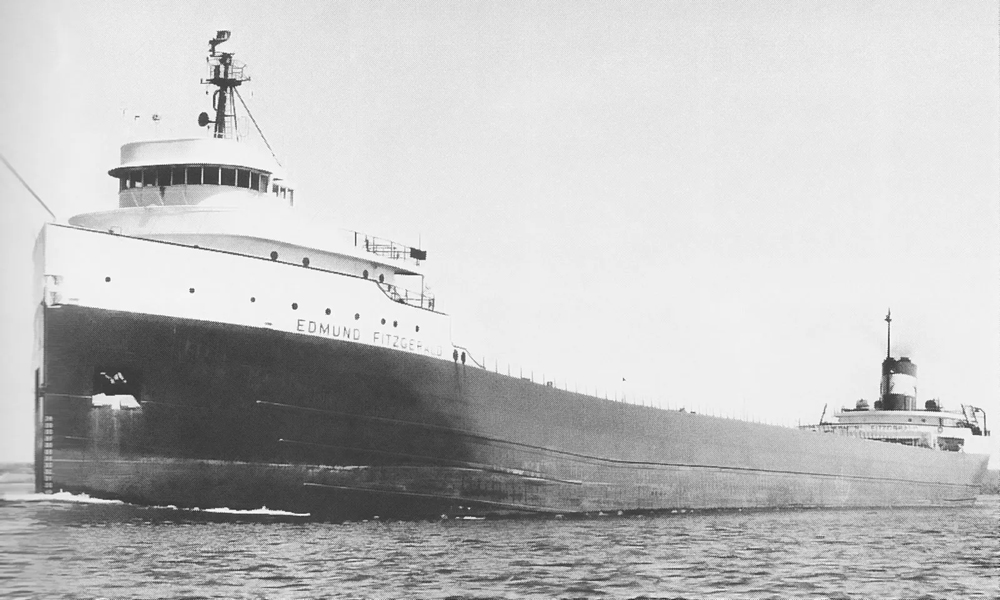
By most accounts, the Edmund Fitzgerald was the greatest ship on the Great Lakes. (Image credit: Encyclopedia Britannica.)
Like most children of the Great Lakes, Bacon thought he knew the story of the Fitz: On Nov. 10, 1975, a massive storm on Lake Superior — complete with hurricane-force winds — claimed all 29 souls aboard what he describes as “the greatest ship on the Great Lakes.” Ironically, the ship was mere miles from relatively calm waters when it disappeared.
It’s been five decades, so what about this tale could possibly be new?
Bacon’s answer: “All of it.”
In the podcast interview here, the animated storyteller shares little-known details and mind-boggling facts about the fury of fresh water lakes, the nature of flexible ships, and the downright terror that came for these seasoned sailors that fateful night. While researching and connecting with their loved ones, Bacon came to revere the ship’s extraordinary crew and their leader, Captain Ernest M. McSorely.
“If you’re going to spend four years writing a book, you better like the people you’re writing about,” he says. “And these were genuinely good guys.”
For a raconteur like Bacon, the tale hits virtually every bittersweet beat: The beloved captain taking one last trip before retirement, the deckhand whose mother had no idea her only son was expecting a child; and the veteran sailor who entrusted his pal to mail a diamond ring to his wife of 25 years, even though he was scheduled to dock in three days. And there’s so much more.
The New York Times bestseller features a number of U-M experts, including naval architects Matthew Collette and Brendan Falkowski in the College of Engineering. Bacon also features Michigan Daily alumnus James Gaines, who wrote the lyrical “obituary” for Newsweek that inspired Gordon Lightfoot’s eerie musical eulogy “The Wreck of the Edmund Fitzgerald.”
In the following excerpt Bacon recounts how the initial news reporting, shaped by one of our own, evolved in the wake of the disaster.
The first draft of history
By John U. Bacon
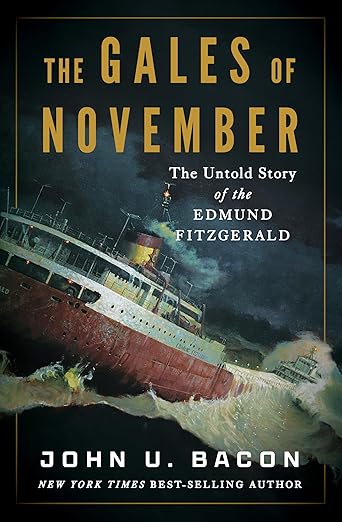
(Liveright, 2025.)
On Monday evening, Nov. 10, 1975, Harry Atkins, an Associated Press reporter based in the Detroit bureau, was working at the downtown office.
Meanwhile, up in Whitefish Bay, an “old hermit” Atkins knew about was listening to his radio.
“His one joy in life was listening to the ship-to-shore stations,” Atkins says, “eavesdropping on the captains talking to one another.”
When the hermit heard the Edmund Fitzgerald’s skipper Ernest McSorley radioing back and forth with Captain Bernie Cooper of the S.S. Arthur M. Anderson during the horrible storm, he tipped off Sault Ste. Marie’s WSOO radio station, which contacted the Sault Ste. Marie Evening News, one of Michigan’s 53 daily papers. Since they were all members of the AP, it made sense for an Evening News reporter to call the Detroit bureau, which employed 26 staffers at the time.
There, on the spot, the Detroit bureau chief made the decision to send a reporter and photographer on a rare overnight trip, all the way to Sault Ste. Marie. He picked Atkins because he’d already written some good stories about the Upper Peninsula, a region he loved, and then told Atkins to pick a photographer.
“When it comes to photographers, you must know they’re all nuts,” Atkins says. “John Hillery was no exception, but that’s what you need. I knew I could count on him to come through with the goods.”
At 8 a.m. on Tuesday, Nov. 11, Atkins and Hillery arrived at the Sault Ste. Marie Evening News, where the editor-in-chief was nice enough to set up workspaces for the two. Atkins figured he should observe the search effort from above, and Hillery needed shots of it, so Atkins started calling around to rent a plane. But when he kept striking out, he feared the whole trip would be a wash.
Help came from across the desk, where one of the local reporters had been overhearing his calls. He told Atkins he had a friend with a plane, and would Atkins want him to ask? That’s how Atkins and Hillery found themselves in a four-seat Cessna at the mercy of a retired Navy pilot with steel gray hair, combed straight back, and his 40-something girlfriend with a beehive hairdo. When they flew over the search ships, Atkins says, “Hillery — who, like I said, was nuts — keeps telling the pilot, ‘If you could just get over there … If you could just go back that way,’ and then, ‘If you could just tilt the plane a bit this way’ — so he could take his shot beyond the wings.“Every time it was ‘No problem!’ Rrrrawr. He’d do it just like Hillery asked.”
They weren’t up too long when the Coast Guard ordered, “All aircraft out of the area!” The pilot turned his radio off, kept flying, and added a tour of the Soo Locks for color. Atkins and Hillery got everything they needed to file their story, a Xerox copy of which Atkins saved.
16:12 11/11/75; Sault St. Marie, Mich. (AP)—
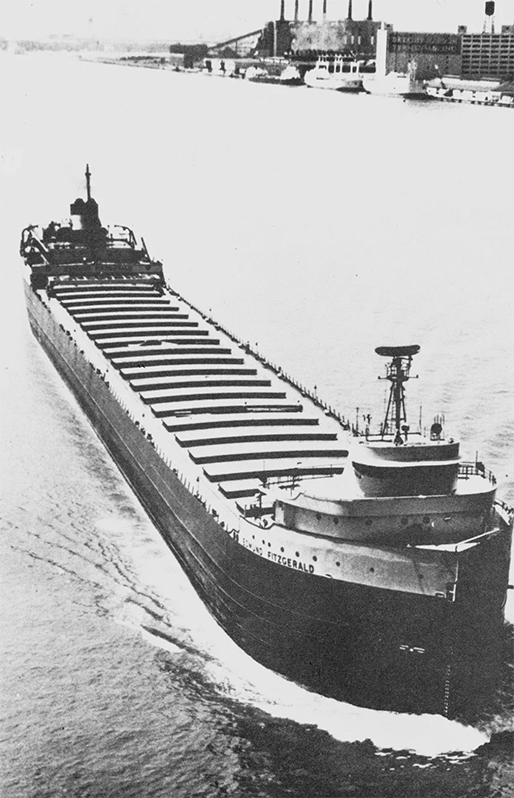
Bacon likens the “absurdly long” ship to a giraffe’s neck. (Source: Encyclopedia Britannica.)
Atkins opened his AP story with a quote from Captain Charles Milradt, commander of Group Soo: “Lake Superior seldom coughs up her victims unless they’re wearing life jackets. As of this time, we have no reason to believe the men of the Fitzgerald had time to get into life jackets.”
It’s striking how many difficult facts Atkins reported accurately in a few hours using only a notebook and an office phone. From his research and his writing, it’s clear Atkins cared about this story more than the job required.
But perhaps the most interesting thing about the piece Atkins sent to Detroit is what it didn’t include: any mention of the Mariners’ Church or its pastor ringing the bell 29 times, especially since those scenes appeared in the final draft of Atkins’ story that went out on the AP wires worldwide, facts that would leave a lasting impression.
“I never wrote about the bell ringing 29 times,” Atkins says, with disarming honesty. “It wasn’t me! I was in the Sault at the time, and had no idea what was happening at Mariners’ in Detroit.”
Atkins suspects that someone in the Detroit AP office read his story as it came in. When they heard the bell chiming at Mariners’ Church, just a few blocks away, they must have walked down to witness Father Richard Ingalls Sr. — who had taken his son on a private tour of the Fitzgerald when it was being built 18 years earlier — ringing the bell.
The final version of Atkins’ story, including the Mariners’ Church pastor tolling the bell 29 times, went out on the wire to the AP’s 6,500 member papers around the world, including The Los Angeles Times.
Cue James Gaines, Michigan Daily alumnus
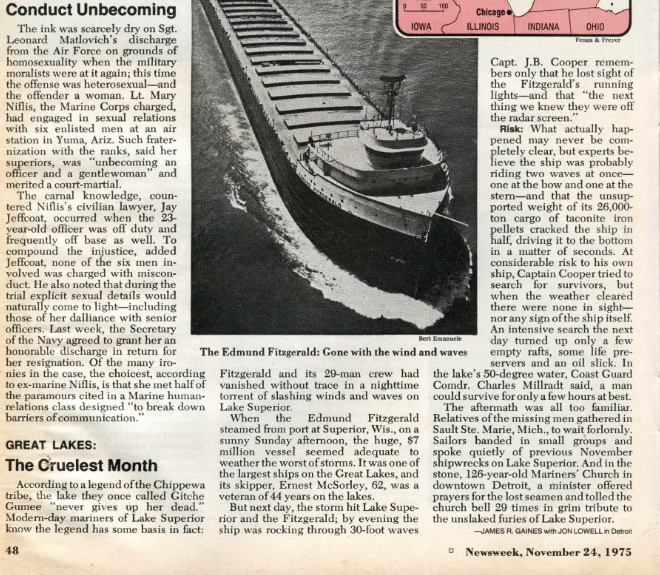
Michigan Daily alumnus James Gaines contributed to this story in Newseek, dated Nov. 24, 1975, regarding the wreck of the Edmund Fitzgerald. (Click the image to enlarge.)
Due to the reports from Dennis Anderson at Duluth, Minn.’s, Channel 10, Harry Reasoner on “The ABC Evening News,” and Harry Atkins at the AP, the Edmund Fitzgerald’s disappearance was soon picked up by all the media available in 1975. The interest in the wreck prompted Newsweek to assign a half-page story for its Nov. 24, 1975, issue, exactly two weeks after the ship sank, that was replete with phrases that still resonate today.
Almost buried among that issue’s 44 stories, eight department dispatches, and various columns — including the debut of a 34-year-old columnist named George Will — was a story on page 48 titled “Great Lakes: The Cruelest Month.” At the end of the piece it credits James R. Gaines with Jon Lowell in Detroit.
Looking back, Gaines is surprised he got a byline on the piece, because Newsweek reporters typically didn’t get one if an article wasn’t longer than a page. But this story was exceptional in several ways, which his editors probably recognized in giving it the space they did.
Gaines had attended U-M, where he spent more time working for the acclaimed student paper, The Michigan Daily, than he did on his English major. Still, soon after he arrived at Newsweek in late 1972, he realized he had a lot to learn.
“Look, I just wasn’t very good,” he says. “I’m close to saying I learned everything I know at Newsweek, especially about writing short, cogent pieces with a little style. I probably couldn’t have written that story even one year beforehand. I credit the guys who were there much, much longer than I had been, who were extremely friendly and helpful. There was no competition, just a spirit of ‘let’s band together and get it done.'”
Gaines quickly got up to speed by “being edited and torn up by two great editors, Peter Goldman and David Alpern — and being humbled, twice a week. Go through enough of that, you learn how to crunch it all down, right to the story’s essential nuggets.”
A lyrical obituary
The Fitzgerald assignment started with Detroit bureau chief Jon Lowell conducting most of the reporting, then sending his file to New York, where Gaines began sorting through the pieces.
“Between Jon and me, who wrote it?” Gaines asks. “I don’t know, but generally the lines from the reporters’ file didn’t get into the story. Jon was really good, though, and I may have used a line or two of his. When I read it now, I’m glad I was able to write it as I did.
“The Edmund Fitzgerald was national news — but only sort of,” he continues. “It was more poetry than news, like an obituary. It’s a really sad story. It was not hard to make it sing.”
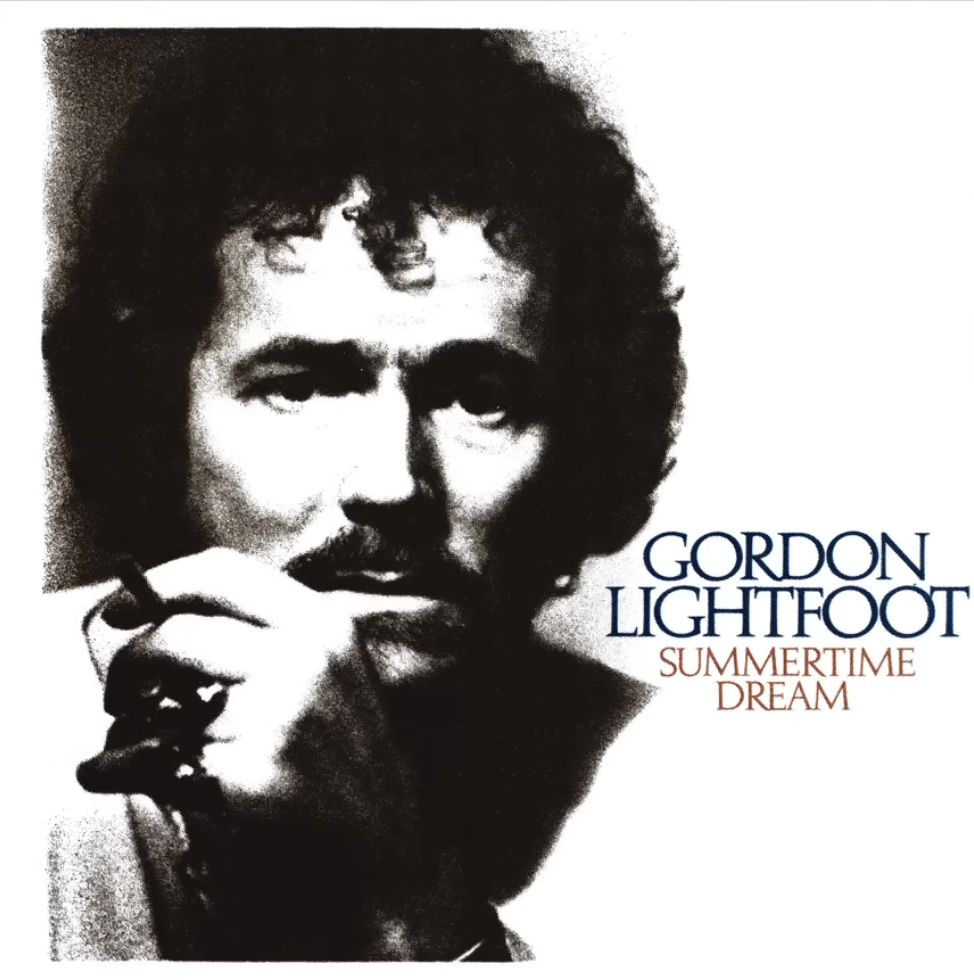
Gordon Lightfoot’s album “Summertime Dream” included the song “The Wreck of the Edmund Fitzgerald.”
And sing it does, from the very first words: “According to a legend of the Chippewa tribe, the lake they once called Gitche Gumee ‘never gives up her dead.'”
The story continued, “Modern-day mariners of Lake Superior know the legend has some basis in fact: The largest and most treacherous of all the Great Lakes, Superior, is also the coldest — deadly not only to man but also to the organisms that infest drowned bodies and bring them to the surface.
“During the gales of November,” the Newsweek authors added, “the lakes can become especially forbidding.”
They then listed other Great Lakes tragedies that occurred on the same deadly day, November 10: the storm of 1913, which killed 254 people; another in 1930, when 67 drowned; and finally the Edmund Fitzgerald, whose 29-man crew “vanished without a trace in a nighttime torrent of slashing winds and waves on Lake Superior,” Gaines writes. “When the Edmund Fitzgerald steamed from port at Superior, Wis., on a sunny Sunday afternoon, [it was] one of the largest ships on the Great Lakes, and its skipper, Ernest McSorley, was a veteran of 44 years on the lakes.
“But the next day,” the story continued, “the storm hit Lake Superior and the Fitzgerald; by evening the ship was rocking through 30-foot waves, and fighting hurricane force winds. Only 15 miles from the relative calm of Whitefish Bay, McSorley radioed the ore ship Arthur M. Anderson, which was a few miles behind, that he was taking on some water . . .”
Gaines closed the piece by writing, “And in the stone, 126-year-old Mariners’ Church in downtown Detroit, a minister offered prayers for the lost seamen and tolled the church bell 29 times in grim tribute to the unslaked furies of Lake Superior.”
Gaines and Lowell got a lot done in just 534 words. They didn’t merely deliver the news but the lore behind it, capturing the heart of the story so well that their lines took root in the mind of at least one reader, a songwriter in Toronto, who read their piece more carefully than most.


chris harner - 1981
Loved reading this excerpt. Thank you! Cannot wait to get John Bacon`s new book.
Reply
Ruth Wilson - 1979
This excerpt was so evocative of the time and the event and the song and the death knell at Mariners. The story was a backdrop to my life in Detroit, as I prepared to transfer from Wayne to Michigan in eight weeks and often attended Mariners. The book is now on my list!
Reply
Ruth Wilson - 1979
This excerpt was so evocative of the time and the event and the song and the death knell at Mariners. The history was backdrop to my life in Detroit, as I prepared to transfer from Wayne to Michigan in eight weeks, and often sang the Naval Hymn at Mariners Church. Bacon’s book is now on my list.
Reply
Beverly Trebesch - 1986
Every time I hear or read about the Edmund Fitzgerald I cringe and tear up. It was no different today. Thank you.
Reply
Helen Bidol - 1986
It was interesting to hear the experiences of the journalists covering this tragic event. Thank you.
Reply
Robert Gilbert - 1963 LS&A; 1966 JD
In the summer of 1959, before my freshman year at Michigan, I was a coal passer on one of the last of the coal burning iron ore boats, the Edward S. Kendrick. When we entered Lake Superior I could see how far below the waterline my workplace was because the steel hull started sweating like a glass of water with ice in it. A cold lake indeed.
Reply
Sarah Newton - BSN 1982, MS 1987, and PhD 1997
I lived in Petoskey in 1975 and news of the Edmund Fitzgerald was broadcast on the radio continuously for two days. It was devastating when it became apparent that the mighty ship and its crew were gone, swallowed by Lake Superior, like so many ships before it. To learn more about the Edmund Fitzgerald, visit the Great Lakes Shipwreck Museum at Whitefish Point near Paradise, MI.
Reply
David Woods - 1986 DDS
Wonderful interview with John Bacon. Ive read several of his books. This one is definitely on my list. I was a freshman and I still remember the wreck around thanksgiving of 1975. I always smile at the University of Michigan connections. What a privilege it is to be an alumni of UM. 😎
Reply
Martha Payne - 1967
I have been reading Tattletale Sounds: The Edmund Fitzgerald Investigations by Ric Mixter. He has interview with the captain of the Anderson and former crew of the Fitz. He details the events of the storm, but also goes through how the Fitz was built. It is a fascinating tale and would I am sure it would compliment The Gales of November.
Reply
Robert Acker - 1969
Great story. I can’t wait to get my hands on Bacon’s book. He gave a talk at the Detroit Observatory on the UM campus but I couldn’t attend, even virtually. There is a Great Lakes Shipwreck Museum at Whitefish Point containing several buildings. When you enter the main building, you encounter the Gordon Lightfoot song. Highly recommended for anyone traveling in the UP.
Reply
Kenneth Green - 1976
I was in my second year of the MBA program when I learned about the tragedy. I read the Newsweek article soon after. When Gordon Lightfoot’s ballad came on the radio I immediately knew where he got the lyrics from. I’ve listened to the song every November 10 ever since. I will definitely read the book.
There’s a lifeboat from the E. F. in the Sault on an old US Steel freighter that I visited in 1985. Oh so sad.
Reply
Timothy Alan Lamb - ‘93 MUP
Another excellent installment by our own John U. Bacon. This book deserves to be widely-read.
Reply
Nancy Meeker - 1981
The story of the Edmund Fitzgerald tears me up every time. I loved Gordon Lightfoot’s ballad; still do. I have learned a lot about the Fitz and the tragedy and Lightfoot’s song. All that knowledge does is reinforce the terrible beauty of the tragedy. They rang the bell 30 times when Gordon Lightfoot died.
Reply
Lori Landsburg - 1969
I grew up in River Rouge, MI. When posters were put up around town advertising the launching of the Fitzgerald, all of us kids rode our bikes down to the Detroit River to see the launch. I was 12 years old. I worked my way to the front of the dock where a man told me that he was worried when the ship was launched that I would be washed away in the big waves that would ensue. It was, after all, a sideways launch. He thus put me up on a telephone pole where I got to see the entire launching. I saw a woman hit the ship with a champagne bottle. When the bottle didn’t break, there were whispers about bad luck for the ship. On the second try, the bottle broke and the launch went on. As everyone was waiting for the launch, I looked back behind me and saw a group of men in dark suits. I found out later that those were naval architecture students from the University of Michigan. I graduated from Michigan in 1969 and married a naval architect who also went to Michigan. Several years later, my husband, Alex, and I were at a Society of Naval Architects and Marine Engineers (SNAME) conference and I was introduced to one of my husband’s fellow naval architects, William Garzke. Eventually, the subject of the launching of the Fitzgerald came up and it turned out that Bill was one of the guys in suits from Michigan watching the launch. Bill went on to author a few books on battleships. We called him Battleship Bill and also Mr. Titanic, as he was on the expedition to find the Titanic. My husband went to work for the U.S. Maritime Administration and authored many papers of note.
Reply
Deborah Holdship
Wow! Amazing connections. Thank you for sharing!
Reply
John Haan - 1978
Such great, professional coverage, proud to be a UM graduate and see such wonderful work!
Reply
Stephanie Wilson - 2024
The sinking of the Edmund Fitzgerald was the first news story I remembered as a child. I was 5 and living in Green Bay, WI when the ship sank. The story hit close to home as many of the crew were from Green Bay. My uncle and grandfather worked on the coal docks in Green Bay and had once toured the ship and met the crew. My uncle said it was hard to comprehend that a ship that large could sink so quickly. As an adult, I have read everything I could about the tragedy. I can’t wait to read The Gales of November.
Reply