
Tappan’s vision
When U-M staffers tallied the total number of this spring’s graduates, someone noticed a striking statistic: In that noisy throng gathered for commencement at the Big House, Michigan’s 1 millionth graduate would be awarded his or her diploma.
A million degrees: An astonishing number. Yet just as astonishing is how Michigan degrees have expanded and diversified over the decades since the first graduates in 1845. Those degrees, scanned from a high elevation over time, trace the growth of the University’s reach and of the impact of higher education in American society.
That first class of graduating seniors numbered just 11. They marched in procession from the campus to the Presbyterian church, where the Rev. George Duffield told them, “We mean it not as flattery, but frankly express our delight when we say to you young gentlemen of the recent senior class: We hail in you a pledge of better things.”
That was certainly what Henry Philip Tappan had in mind when he became the University’s first president in 1852. He envisioned a university that would pursue and spread knowledge in every imaginable field, from the most esoteric to the most practical. By so doing it would help to nurture a distinctly American civilization, yet also establish the United States as a full participant in the learned conversation of all peoples.
Those first 11 graduates couldn’t have imagined such a project. But as the University grew and its degrees multiplied, step by step, Tappan’s vision began to take concrete form in the growing campus.
The essential tools of a learned mind
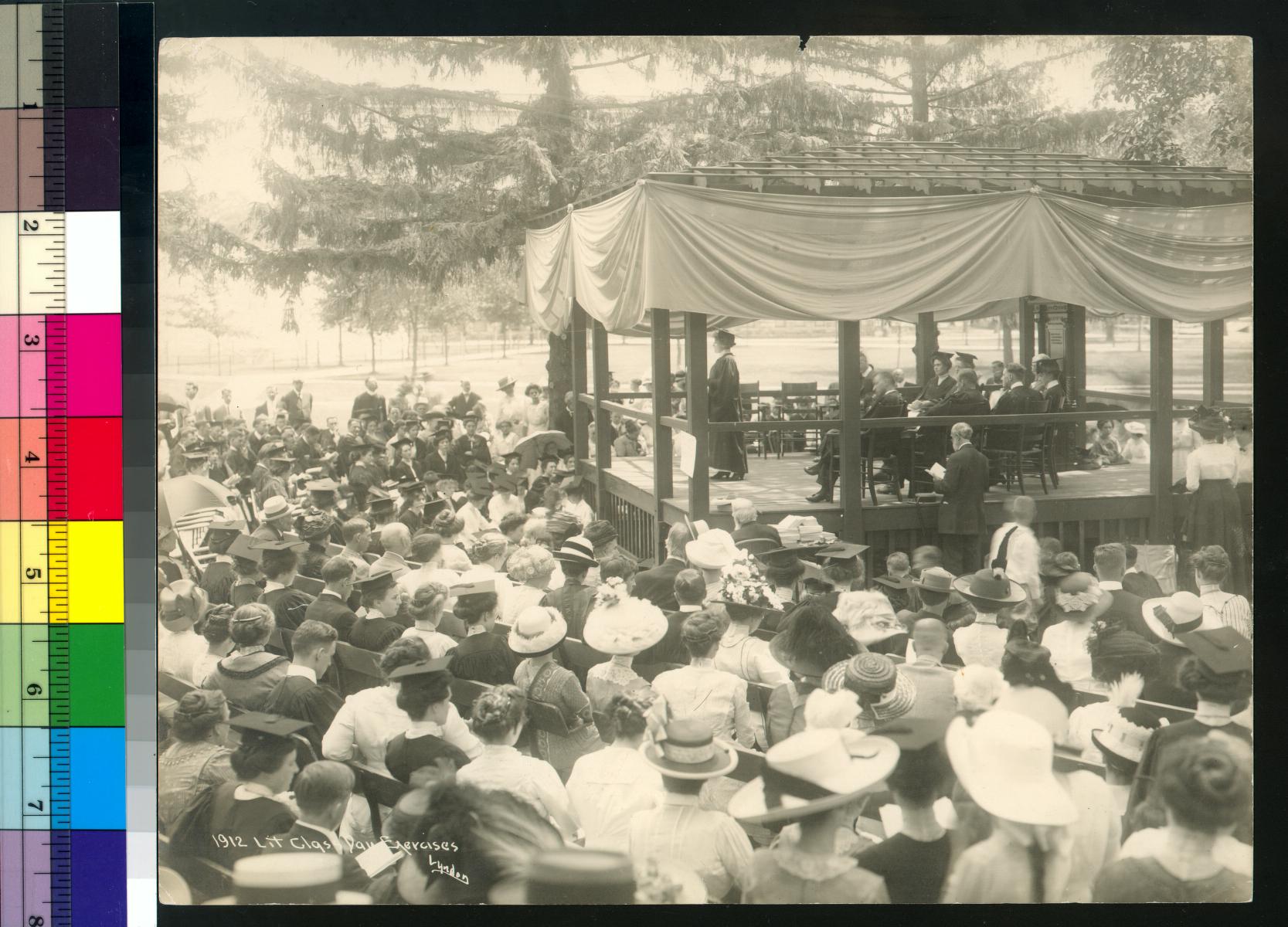
Literary Class Day Exercises, 1912. (Image courtesy of U-M’s Bentley Historical Library.)
“Bachelor of Arts” (technically, Michigan’s degree was Artium Baccalaureus, abbreviated A.B.) was the sole degree awarded at that first commencement and for some years after. The term came from the medieval universities of Europe, and the “arts” referred to the essential tools of an educated person — the seven “liberal arts” of grammar, rhetoric, logic, geometry, mathematical theory, and astronomy. (No matter that U-M didn’t actually teach all those in the early years.)
BA students of the 1800s were taught mostly in the original buildings along State Street, chiefly University Hall, completed in 1871 about where Angell Hall stands now. They were joined in the 1850s by the first Bachelors of Science (BS) in 1855, with specialized BS degrees soon to follow in biology, chemistry, and forestry.
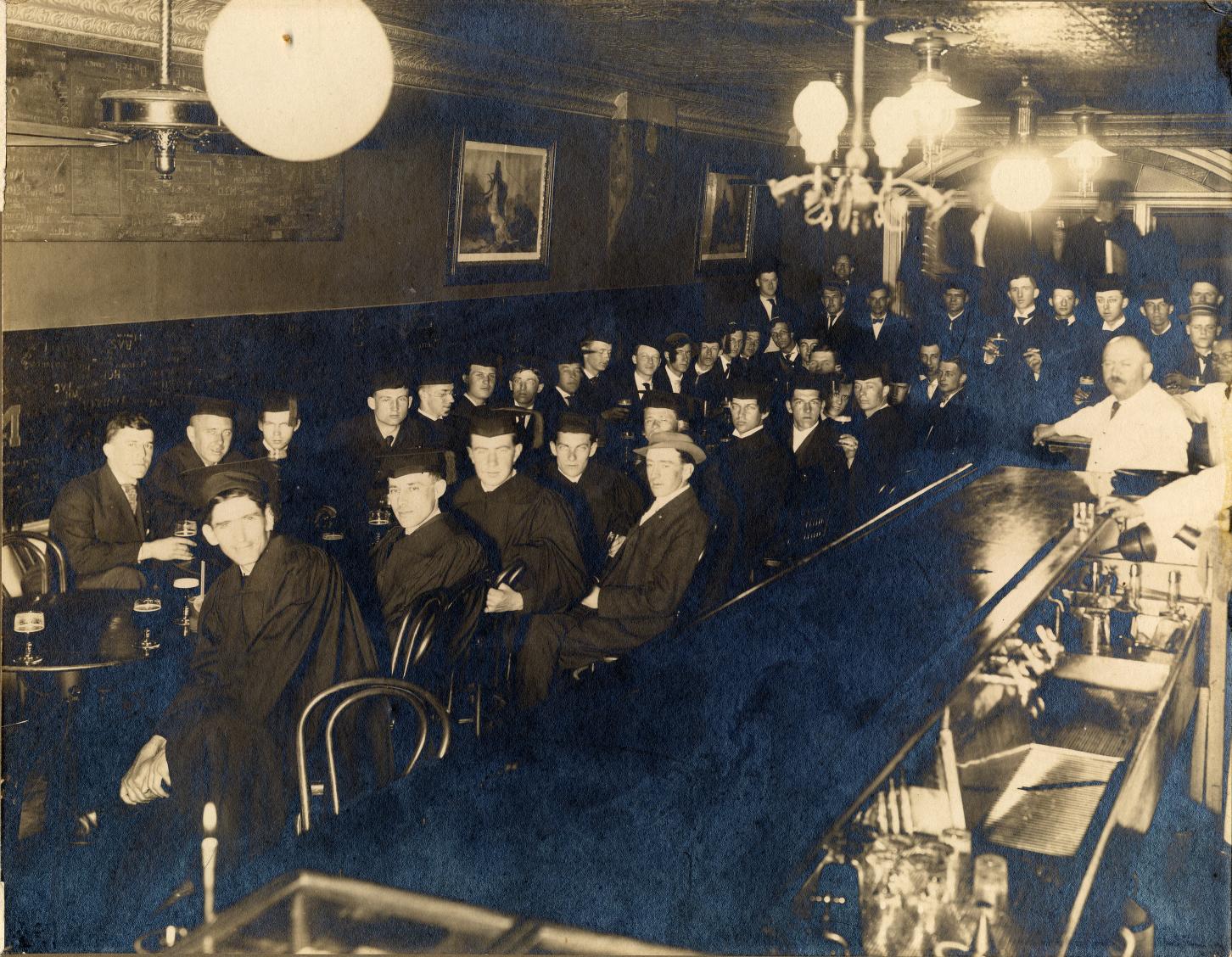
Some traditions never change. Graduates celebrate at the popular student hangout Joe Parker’s Place. (Image is from about 1913-18, courtesy of U-M’s Bentley Historical Library.)
Higher degrees came soon — the master of arts (MA), awarded by the Department (not yet a “college”) of Literature, Science, and the Arts (LSA) in 1849, which qualified a graduate to teach others; then the doctor of philosophy (PhD) degree, also in LSA, first awarded in 1876. Here, too, the modern connotations are misleading. “Philosophy” referred to all branches of learned inquiry, and a “doctor” had achieved an elite level of expertise in his (not yet her) chosen specialty.
Two professional degrees were also awarded early — in law and medicine, with buildings of their own on State and East University — but their numbers rose only slowly.
A key change came not long after the Civil War, as the U.S. was shifting from a nation of farmers to a nation of builders — an urban-industrial society. In those years, LSA dominated in the awarding of undergraduate degrees (and still does). But the campus saw a challenger in the emerging field of engineering — the first civil engineering lecture took place in 1854 with mechanical and mining coming in the 1880s; then electrical and marine in the 1890s; with more specialties to follow in the 20th century. Those students earned the Bachelor of Science in Engineering (BSE), and the building called West Engineering rose to house them in 1904, the anchor of the Diag’s southeast corner.
Professionals for modern society
In the early years of the 20th century, the professions grew and multiplied to administer the specialized needs of an increasingly complex society. So U-M saw corresponding growth in its decades-old degrees in medicine (Doctor of Medicine, 1851) and law (Bachelor of Laws, 1860).
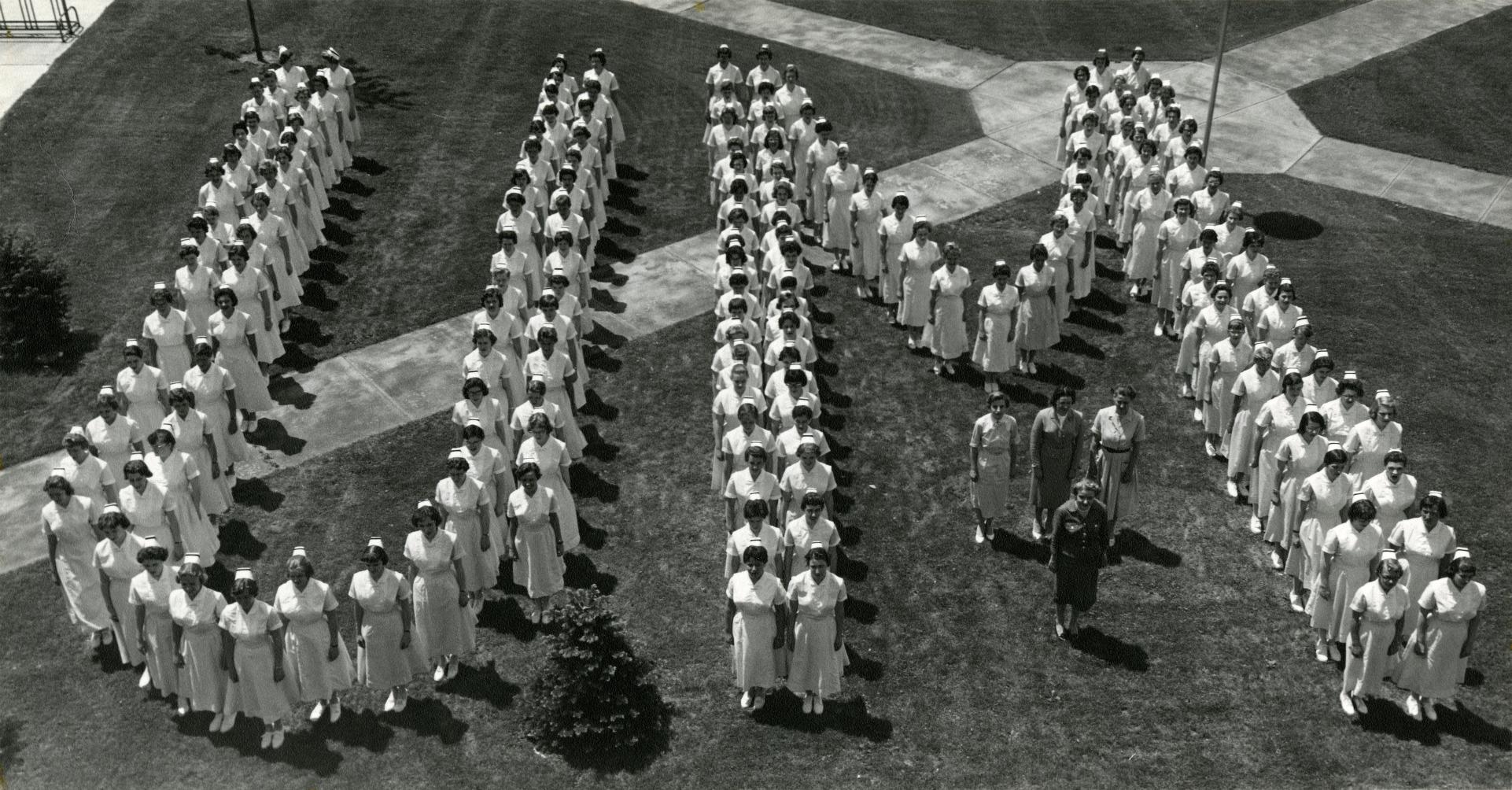
Class of 1960 Nurses standing in U-M formation on the Diag. (Image courtesy of U-M’s Bentley Historical Library.)
The age-old endeavor of commerce gave birth to a newly professionalized field — business administration. And enormous new buildings rose to symbolize the new prominence of these fields — the William Wilson Cook Law Quadrangle in the 1920s and ’30s; the new University Hospital in the same decade; and the School of Business Administration in the late 1940s. Other professions grew their own units and buildings: nursing, dentistry, pharmacy.
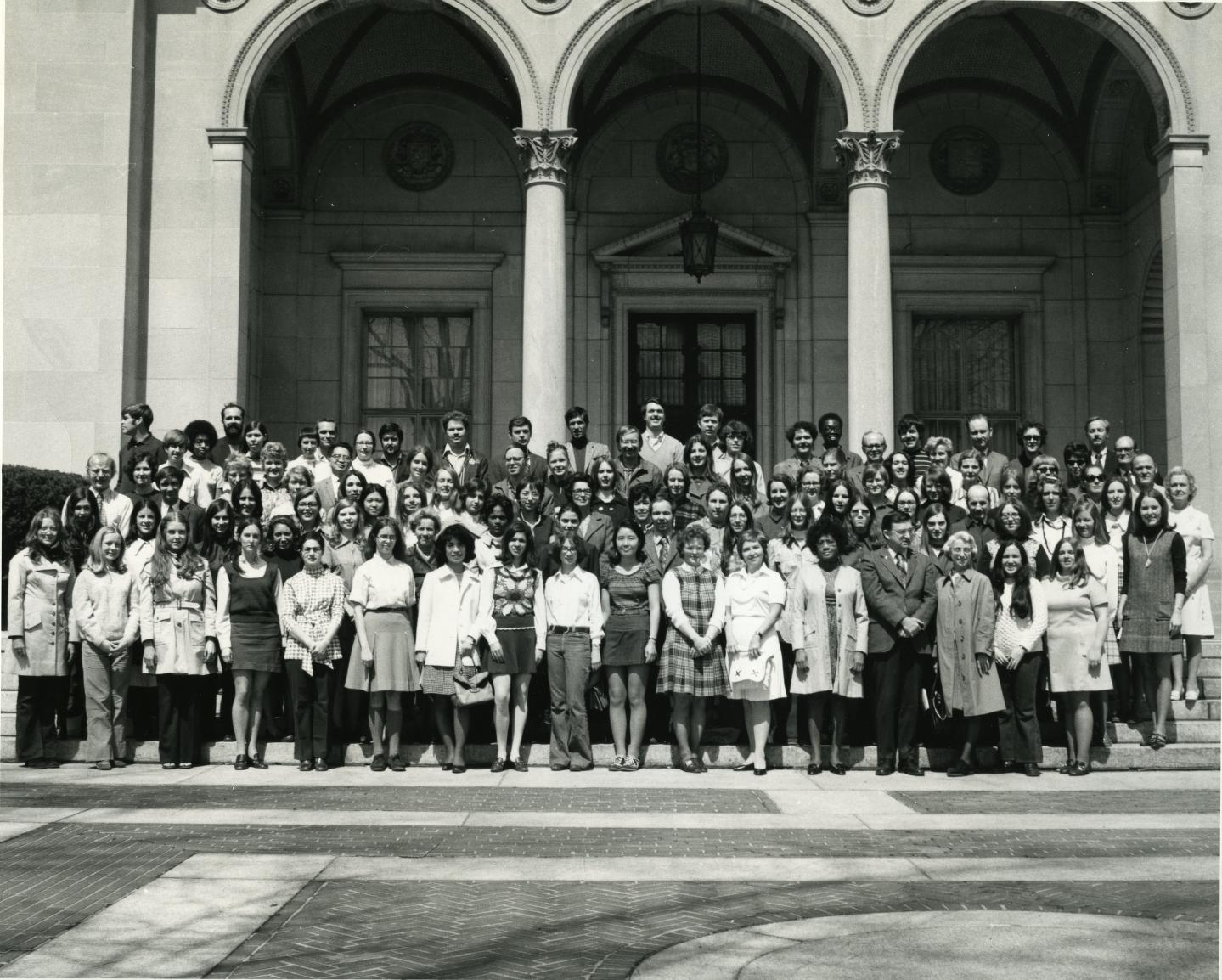
The Library Science Class of 1972 featured a majority of female graduates. (Image courtesy of U-M’s Bentley Historical Library.)
The urban-industrial society that emerged in the late 1800s spawned an array of deep-seated social needs. Here, too, Michigan responded with new degree programs — the BA and BS in education (1922); the Master of Public Health (1935); the Master of Social Work (1937); and the Master of Public Policy (1968).
The years after World War II saw the march of the technological fields to the new North Campus, with engineering and scientific specialties producing graduates in the brand new fields pf aeronautics, computer science, and nuclear engineering.
Some degree programs were transformed within a few decades. Library science, for example, a new field in the early 20th century, got its own degree program, only to morph by the end of the century into the ultra-modern School of Information.
Vision realized
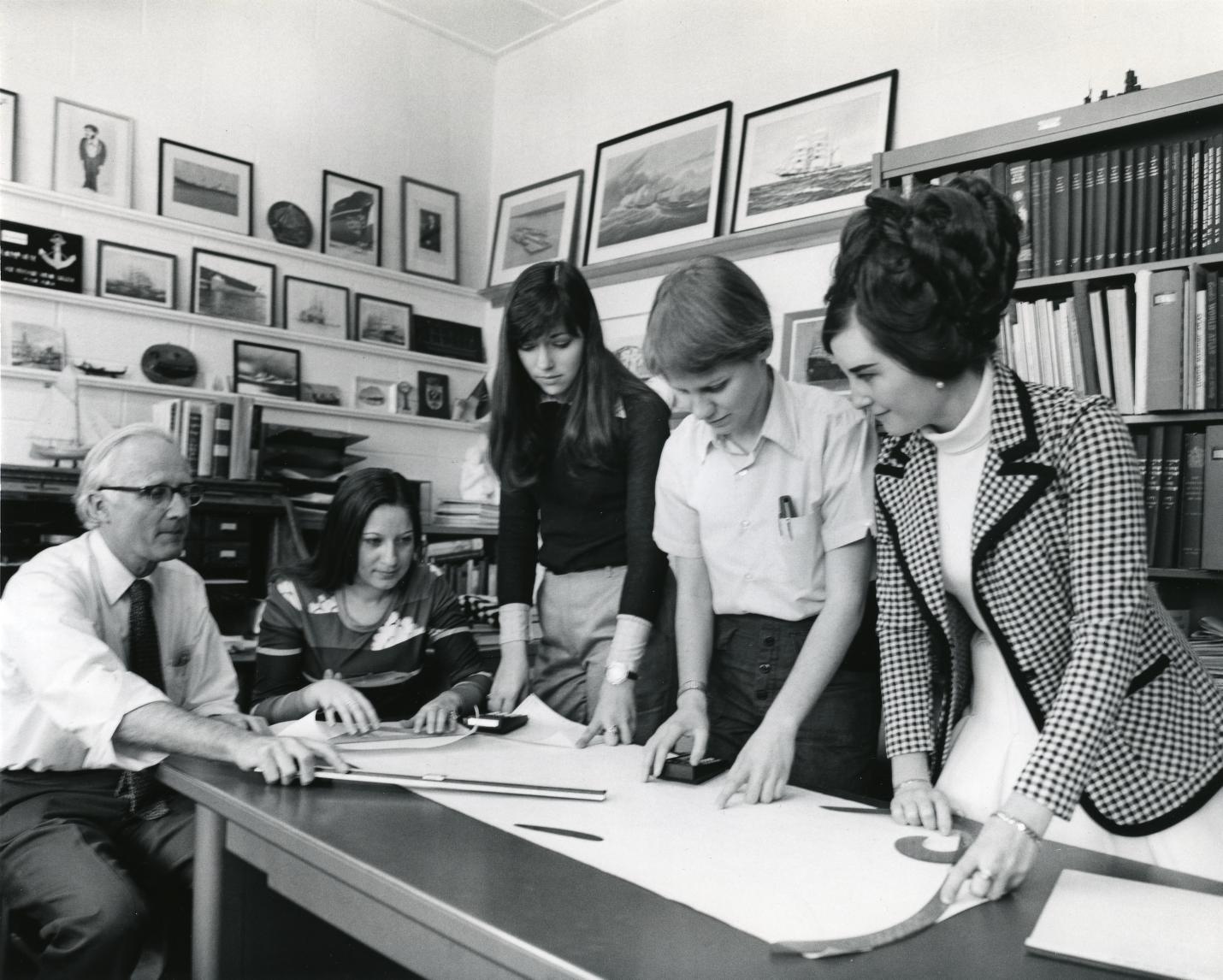
Future engineering graduates meet with their professor in 1974. (Image courtesy of U-M’s Bentley Historical Library.)
If President Tappan could see the graduates arrayed in Michigan Stadium this spring, he might wonder at the full flowering of his vision.
He would see graduates at the bachelor’s, master’s and doctor’s levels ranging from the core fields of the old liberal arts — as well as the performing arts of music, theater, and dance — to fields he likely could not have imagined such as kinesiology (with its own school); urban planning; and the environment and sustainability. He would see students earn hundreds of undergraduate majors spread across 19 colleges and schools, and advanced degrees awarded to specialists in more than 180 graduate programs.
In his inaugural address, Tappan had said: “We cannot entail estates in our country to our legal heirs. But an estate might be entailed in a great University as long as our country shall exist — a splendid beneficence, a monument worthy of the ambition of any man…”
His ambition was fulfilled.
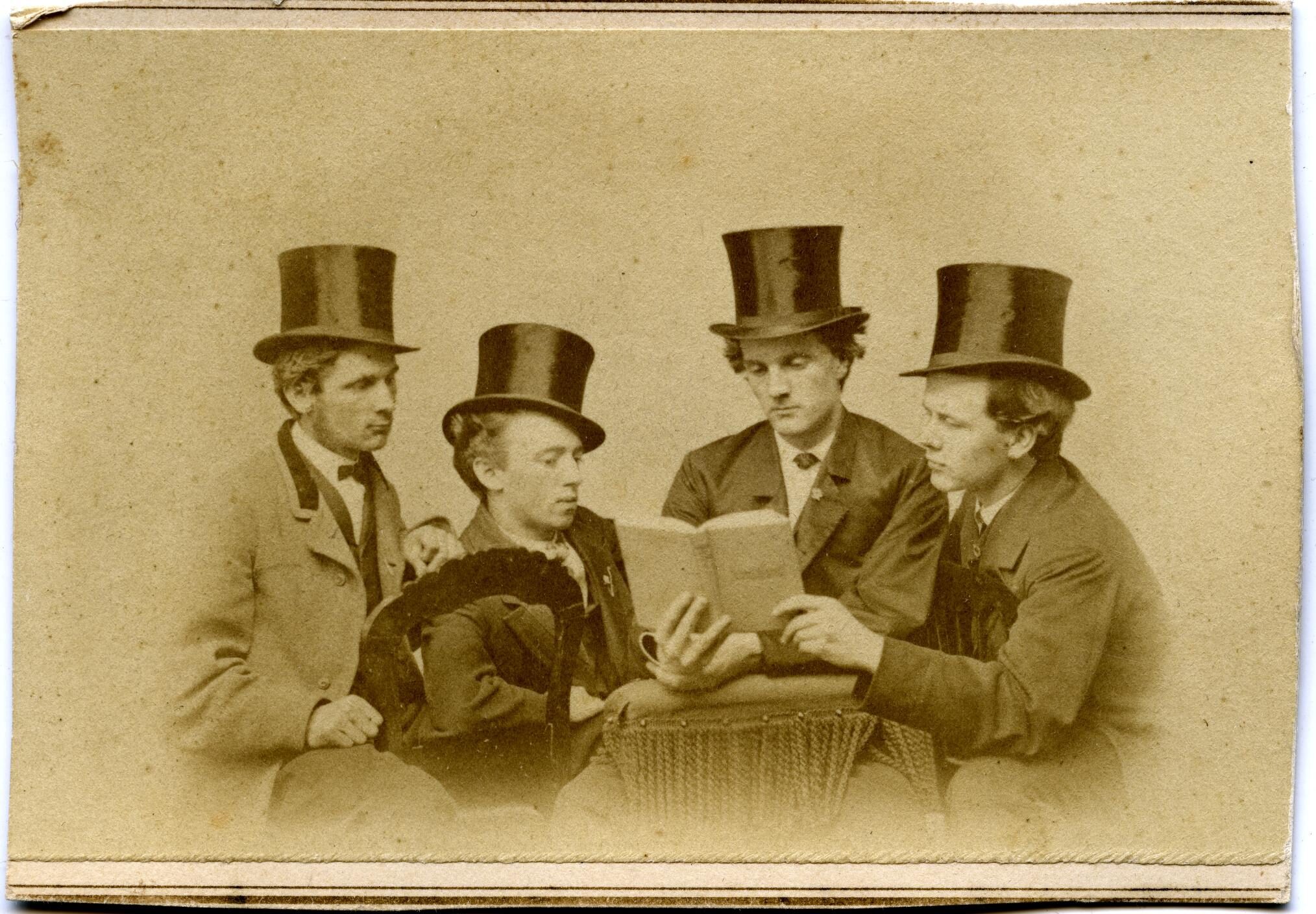
(Lead image: Four graduating students “reading a book,” 1869. (Image courtesy of U-M’s Bentley Historical Library.)


john Ben Ten - 2024
This was an inspiring milestone to read about. Reaching one million degrees reflects not only academic achievement, but also the long-term impact a university can have on communities, industries, and future generations. I especially appreciated the emphasis on how education continues to evolve while still maintaining its core purpose of creating opportunity and positive social change.
It also highlights how institutions and professionals in every field rely on strong systems, guidance, and accountability to support people effectively. Overall, this was a meaningful reflection on growth, legacy, and the broader value of higher education.
Reply
Chris Campbell - Rackham '72;Law '75
My sister and I were looking over high school yearbooks and remarking at how many of our most memorable teachers were U-M grads. They worked so hard to pass on knowledge and analytical capacity to reluctant teenage brains. Later, my state gave me the great gift of 4-1/2 years at this wonderful institution and two of those million degrees. Pres.Tappan’s optimism about the positive effects of a great public university was justified. Now it’s discouraging to see national political figures attacking universities generally, and scientific inquiry more specifically. Our universities and research prowess have made the U.S. a world leader. We ought to celebrate that
Reply