
A mentor’s opus
“Bassoon. Bassoon!”
The visiting composer is suddenly animated as she beckons to the musician crossing the lobby at Rackham Auditorium. She doesn’t know his name because he too is visiting, representing the Karajan-Akademie of the Berliner Philharmoniker. Both have just wrapped a rehearsal for the performance that will end a weeklong collaboration between the University Musical Society, U-M’s School of Music, Theatre & Dance, and the Karajan-Akademie.
“Magnificent playing,” says the composer. She is Residential College alum Julia Wolfe, BA ’80, university professor and artistic director of music composition at NYU’s Steinhardt School of Culture, Education, and Human Development. “Tell me your name.”
The bassoonist is Oskar Chodora from Berlin.
“You have illuminated the bassoon in a gorgeous way,” Wolfe says.
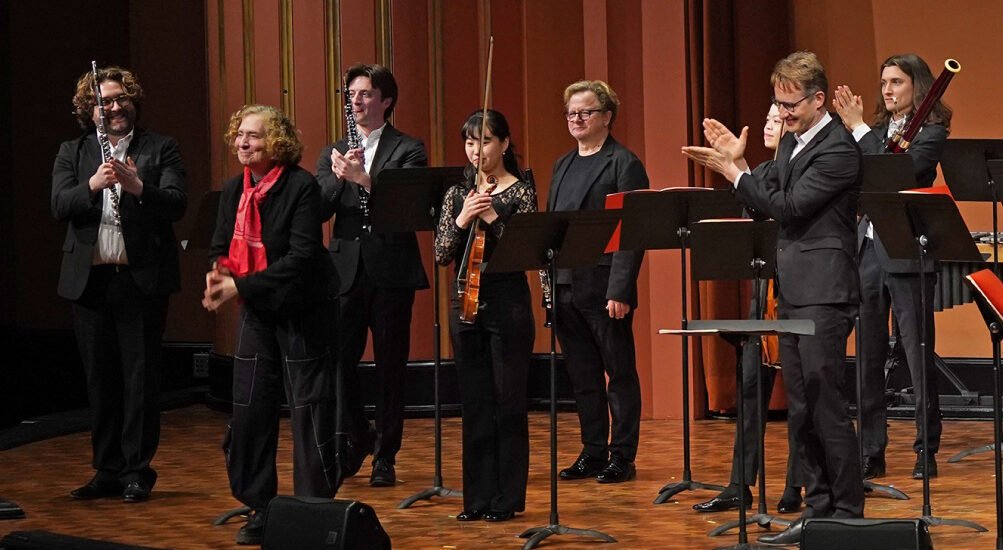
She just witnessed Chodora and 11 other student musicians cohere into an orchestra before her eyes as they adapted her 2012 composition “Reeling,” which opens with rhythmic, wordless mouth music by an unidentified French-Canadian folk artist. The players enhanced the vocalization by snapping their fingers and stomping their feet. Their version is called “Big Reeling”; SMTD commissioned the energetic new arrangement.Chodora is pleased with Wolfe’s affirmation; he is rarely confronted with contemporary, Northern American music, he says, and the vocalist’s “little crescendos” informed his interpretation.
Wolfe likes this attention to detail. “You’re really listening,” she says. “That’s fantastic because you can just play the notes on the page.”
He shrugs. “You said: ‘Do what the singer does.'”
This is music to the mentor’s ears. “I really love your playing,” Wolfe tells him.
“Thank you,” Chodora says. “Then I am happy.”
Labor of love
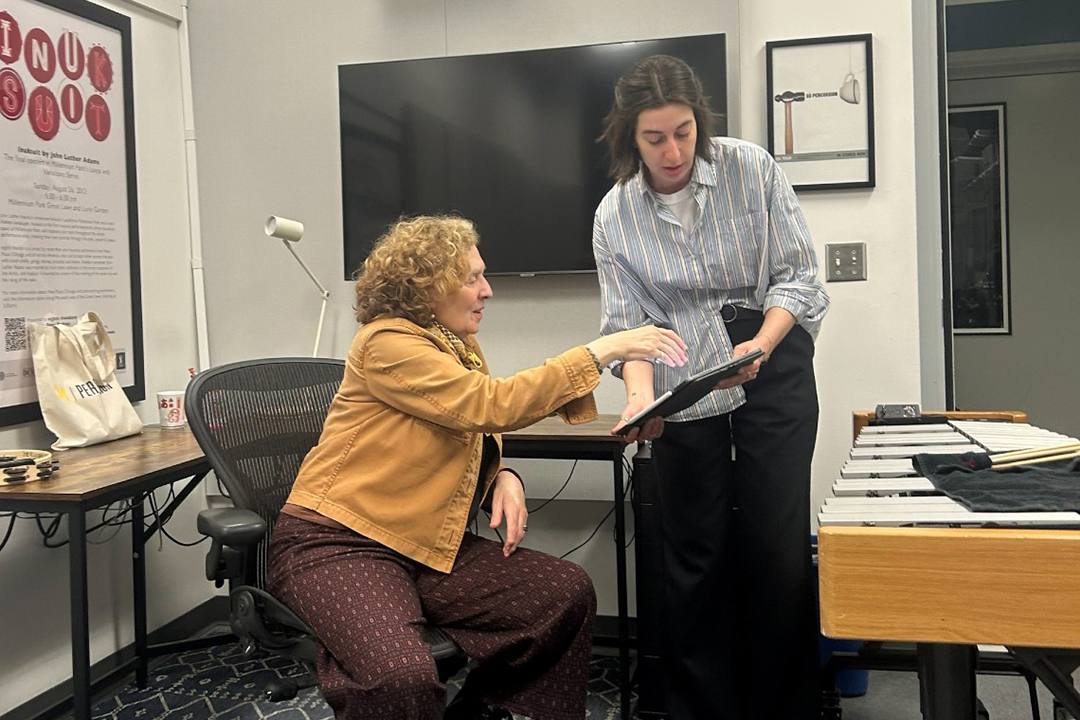
Composer Julia Wolfe working with SMTD percussion student Paige Madden. (Image courtesy of UMS.)
When Wolfe, a 2016 MacArthur Fellow and recipient of the 2015 Pulitzer Prize for Music, moved into U-M’s Residential College as a first-year student in the late ’70s, she came with a guitar strapped to her back and an interest in workers’ rights. She had studied piano but had limited experience composing.
Decades later, the artist is known for writing large-scale, multimedia works inspired by her emotional response to history. Reviewers from The New York Times to The Guardian describe her style as dramatic and visceral, intense, relentless, and aggressive. Influences combine classical, folk, and rock music.
Wolfe received the Pulitzer in music for “Anthracite Fields” (for chorus and instruments) about the plight of coal miners in Pennsylvania. The 1911 disaster at New York’s Triangle Shirtwaist Factory is the subject of “Fire in my mouth,” commissioned by the New York Philharmonic; it features a women’s chorus of 146 singers who represent the laborers who perished. Climate change is the focus of the more recent “unEarth,” which received its U.K. premiere in January 2026 at London’s Barbican Centre.
Wolfe’s music also is featured in two distinct residencies with the BBC Symphony and in Belgium (at Bozar) during the 2025-26 season. The Philadelphia Orchestra will premiere her “Liberty Bell” during the 2026-27 season at Carnegie Hall.
How could a weeklong residency in her old stomping grounds possibly compare?
“I could pinch myself sometimes,” she says. “If someone had said to me when I was here studying that I would be doing this — that someone would invite me back or that I’d be doing these really exciting projects around the world — I’d be like, ‘What?’ This is a beautiful part of what I do — connecting with people.”
As for the young musicians performing her work: “I can’t even imagine playing on that level as a student. They’re just phenomenal.”
Building things

Bang on a Can founders David Lang, Julia Wolfe, and Michael Gordon. (Image credit: George Etheredge.)
Revisiting the RC and reconnecting with her mentor Jane Heirich floods Wolfe with memories about the genesis of her career.
Heirich, now 92 and retired from U-M, took a non-hierarchical approach in her course “Creative Musicianship,” which was a revelation to the young Wolfe. There was no high art, no low art; just material that ranged from Bach to Brubeck. That approach set the future composer on a creative path that would incorporate vocals, musical theater, movement, oral histories, speeches, and a wide range of sound effects into her work.
“I didn’t really understand what it meant to compose music until I took Jane’s class and realized, ‘I’m actually going to make something,'” Wolfe says. “It became clear that we were going to build things out of music, almost like architecture, and I really wanted to build things.”
Wolfe pursued additional music, dance, and voice classes, eventually becoming Heirich’s teaching assistant.
During her last year at U-M, Wolfe studied theater with RC faculty member Hilary Cohen, who founded Ann Arbor’s Wild Swan Theater Company. She accepted Cohen’s invitation to join the troupe, which sparked the musician’s appetite for working with larger groups. Wolfe went on to study music composition at the Yale School of Music where she met Michael Gordon and David Lang. Together they created the adventurous NY-based collective Bang On a Can.
Bang it out
As with most live performances of her work, the U-M and Karajan students’ interpretation of “Big Reeling” required them to balance musicality and theatricality.
“[Members of the orchestra] are not often asked to embody something other than their instrument,” Wolfe says. “This music is asking for a certain kind of physicality, remembering that we have bodies.”
As Simon Rössler, percussionist and managing director of the Karajan-Akademie, prepares the temporary collective to run through “Big Reeling” one last time, a shout of encouragement comes from Doug Perkins. He is chairman of percussion at SMTD, and one of Wolfe’s longtime friends. He and Wolfe are standing in the aisle at Rackham, heads together, nodding and smiling as the finger-snapping and foot-stomping resumes.
“Pretend you’re cool rockers in a stadium and not quiet orchestra people,” Perkins calls out.
‘The ultimate diplomacy’
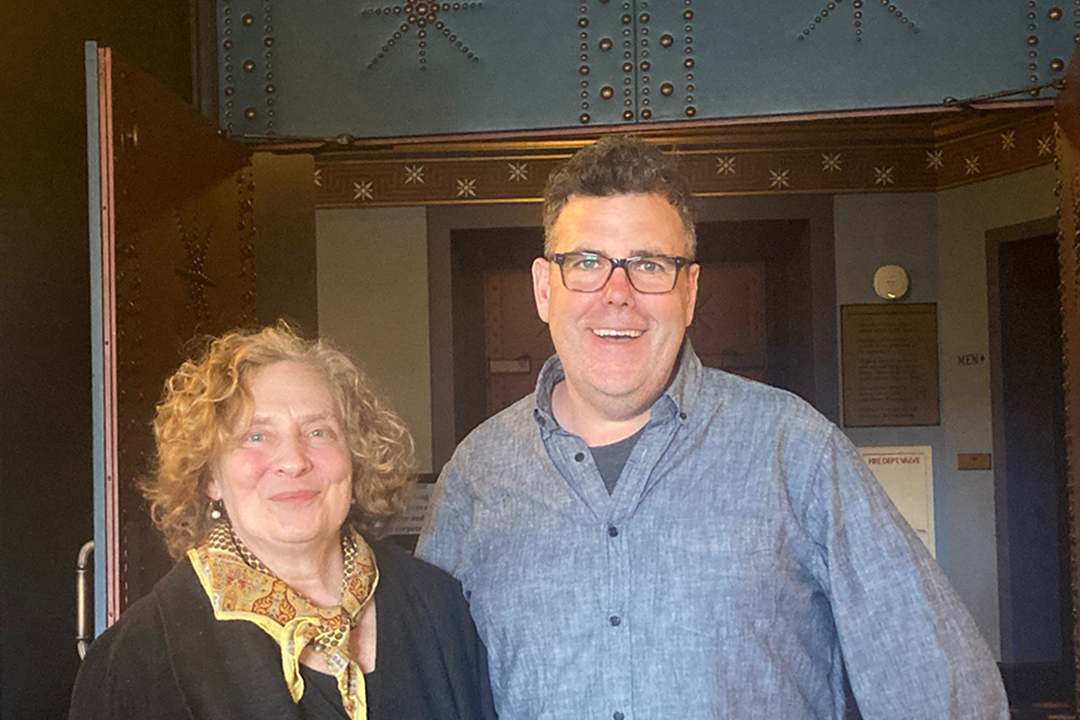
Composer Julia Wolfe and SMTD Percussion Chair Doug Perkins are longtime friends and collaborators. (Image: D. Holdship.)
In addition to his work at U-M, Perkins is a frequent collaborator with Bang On a Can. He is the reason Wolfe and the Karajan contingent are here this week, having extended the invitation for both of them to engage with SMTD, UMS, and the RC. It’s just another interaction in a long list of collaborations and connections Wolfe and Perkins have enjoyed through the years.
“When I wanted to be a professional, Julia’s organization did what they do and extended a hand to give me an opportunity,” Perkins says of the full-circle moment. In fact, “Reeling” was originally written for the Bang On a Can All-Stars.
Trombonist Aiden Drysdale, BMus ’23/MMus ’26, experienced his own full-circle moment performing Wolfe’s music on the Rackham stage. “Reeling” appeared on one of the first instrumental albums the young musician discovered as a high school freshman in Grand Blanc, Mich. He hopes to join a professional orchestra and is passionate about teaching. In 2025, he toured the state with the U-M Symphony Band, visiting high schools and mentoring young musicians.
It was nerve-wracking at first, he says, performing Wolfe’s original piece under the composer’s watchful eye. But, like any good mentor, she put the musicians at ease during their initial interaction, explaining where the piece came from and then leaving the ensemble to its own devices.
“She showed a lot of grace when she came and talked to us at the beginning of the week,” Drysdale says. “You don’t always get that with a composer.”
Wolfe’s residency ended with a larger program that included additional U-M ensembles, all of which dissolved back into the ether once the last note sounded. For now, at least. The visiting Karajan-Akademie students returned to their base in Berlin, the SMTD students moved on to new projects, and Wolfe prepared for the next musical adventure.
“I see myself in everybody here,” she says of the students she met. “I forget that I’m not their age, but I think that’s because we’re all trying to do the same thing; sharing the same passion.”
(The performance was funded in part by a grant from the Arts Initiative at the University of Michigan. Lead image: The Rackham audience expressed huge enthusiasm for Julia Wolfe’s “Big Reeling,” an energetic new arrangement commissioned by SMTD. Six SMTD musicians accompanied the Akademie fellows on stage during the performance and joined the audience in applauding the composer’s brilliant work. Image courtesy of the University Musical Society.)

