

From Peru to Pulitzer
Gabriela Lena Frank, the 2026 winner of the Pulitzer Prize for Music, credits her mentors at the School of Music, Theatre & Dance with cultivating the passion that fuels her creative sense of adventure.
The renowned pianist’s Pulitzer-winning work, “Picaflor: A Future Myth,” premiered March 13, 2025. The piece is a modern symphony inspired by Frank’s Peruvian heritage and her personal experience with the California wildfires. The Philadelphia Orchestra commissioned “Picaflor” and performed it with conductor Marin Alsop.
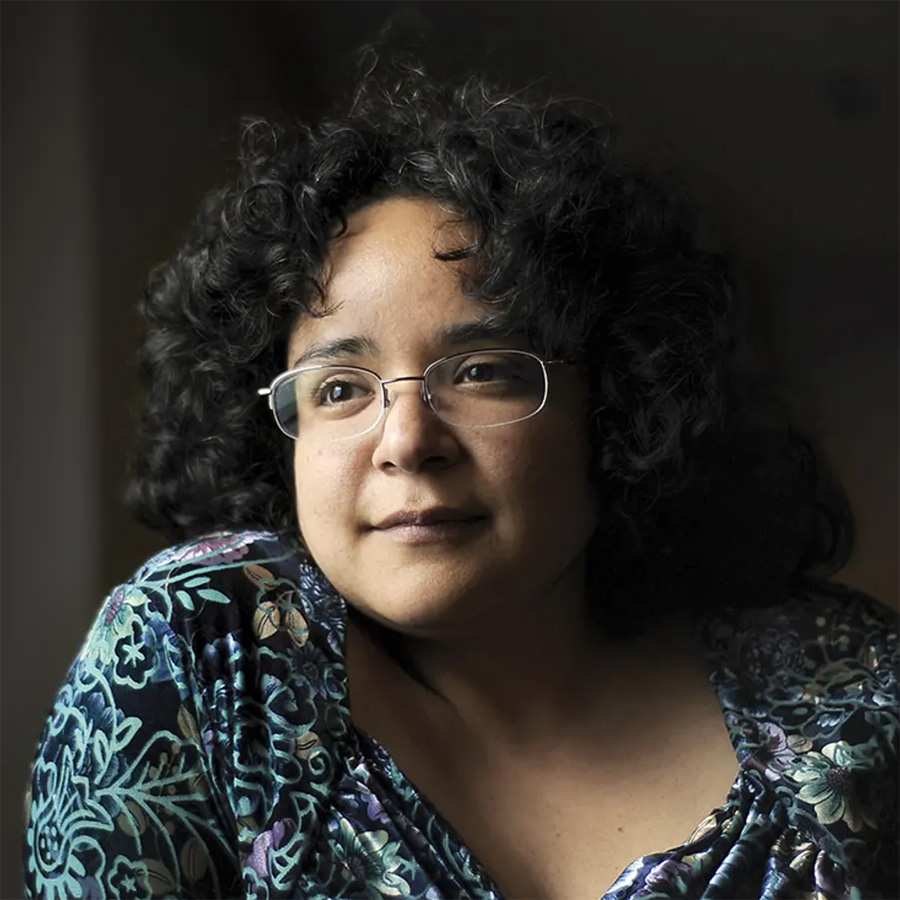
Gabriela Lena Frank
Frank earned a 2001 doctorate in musical composition under the guidance of SMTD faculty members William Bolcom, Logan Skelton and Leslie Bassett. The composer now joins ranks with two of those mentors who also won the prize for music: Bolcom in 1988 and Bassett in 1966.
“They encouraged and were fascinated by my travel to Peru, my mother’s homeland, which began during my grad school years at Michigan,” Frank said. “This had a huge impact on my artistic life … I was with them all for a significant length of time and they encouraged my exploration of my heritage.”
Frank also follows in her mentors’ tradition as artists and teachers. In 2017, she founded the Gabriela Lena Frank Creative Academy of Music in Northern California to allow emerging composers to work with renowned performers.
That same year, Frank was included in The Washington Post’s list of the 35 most significant women composers in history. Composer Julia Wolfe, a 2015 Pulitzer Prize winner and a 1980 graduate of U-M’s Residential College, also appears on the list.
In 2020, Frank received the prestigious 25th anniversary Heinz Award in the Arts and Humanity category, which recognized her efforts to eliminate gender, disability and cultural barriers in the classical music industry, as well as her activism on behalf of emerging composers of all demographics and aesthetics.
The award was especially meaningful: Frank was born partially deaf and later, due to Graves’ disease, lost most of her sight in her right eye. She donated a portion of the $250,000 prize to the nonprofit academy that bears her name.
Future myth
Throughout her career, Frank’s music has reflected and refracted her studies of Latin American folklore, incorporating poetry, mythology and indigenous musical styles into a unique classical framework.
“Picaflor” maintains that tradition. The piece is a reimagining of the traditional Andean Peruvian myth of the Sky Kingdom and its Sun God. Picaflor is a heroic hummingbird on a mission to save Pachamama — “Mother Earth” — from ecological disaster.
While her heritage has long been an inspiration for her work, Frank’s activism and influence around climate change is more recent.
“My viewpoint of a fragile future came much later, long after school,” she said. “I had to experience fire up close and personal in my beloved home state of California before this shifted inside of me.”
As the world continues to change, Frank sees a need for the stories that inspire us to continue to change as well. “Picaflor” is part of that reimagining.
“The situation we are in in this current moment is so urgent that the mythologies that grounded our ancestors and still undergird our cultural ethos today often must shift. I feel a great deal of alarm and I do think we are losing our way of life,” Frank said.
“But as the Picaflor, the small hummingbird at the center of my piece, shows us, we can be selfless and courageous. We can change. I hope my audience for this piece feels both the bigness of this moment in our history, its emergency, and its opportunity for a renewed future if we are just brave enough.”
Frank, who has historically been wary of major prizes and how they may “exert a significant pull on artistic choices,” prefers instead to “keep my head in the score and look up to study our history as a planet filled with living creatures and Pachamama, and to study the current times.”
The Pulitzer came into her life “in the best way,” she said, “for a piece of music I composed as if it were my last. ‘How do I want to go out?’ was my thought at the time. ‘What do I really want to say?’ And now this message has been magnified tremendously because of the Pulitzer. The Picaflor and I are very grateful.”
Theme and variations
Among her extensive career achievements, Frank has received orchestral commissions and performances from the Chicago Symphony, the Boston Symphony, the Atlanta Symphony, the Cleveland Orchestra, the Philadelphia Orchestra and the San Francisco Symphony. In addition to composing “Picaflor: A Future Myth” for the Philadelphia Orchestra, she has held composer residencies with the Detroit Symphony and the Houston Symphony.
She also is regularly commissioned by luminaries such as cellist Yo Yo Ma, soprano Dawn Upshaw, the King’s Singers, the Kronos Quartet, Brooklyn Rider and conductor Yannick Nézet-Séguin.
In May and early June 2026, Frank’s “El Último Sueño de Frida y Diego” was staged at the Metropolitan Opera in New York City.

