
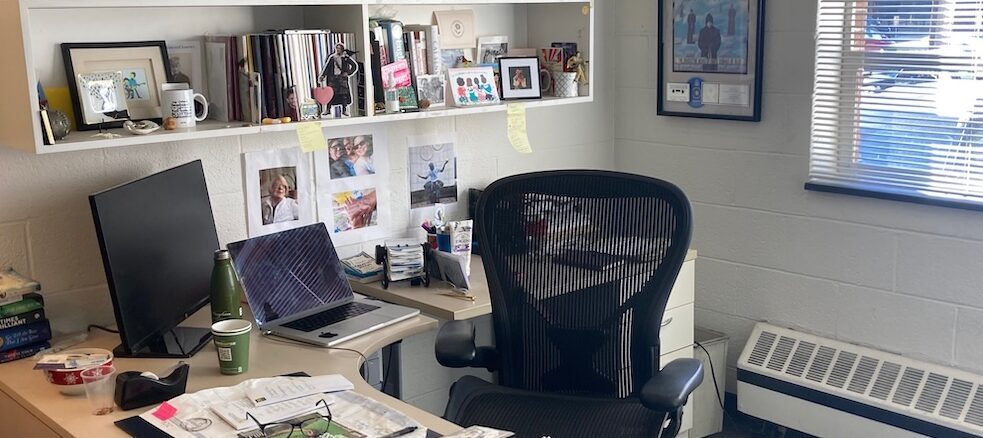
Cinder block paradise
For more than a decade, I’ve transmitted these Michigan Today missives from a place called Michigan News. It’s a nondescript, two-story building with cinder block walls and clanging steam pipes overshadowed by its more elegant and architecturally intentional neighbor, The Michigan Daily.
This fall, University of Michigan Press published Our Michigan: Spaces & Places, a coffee table book with U-M’s physical plant as its main character. Tracking the University’s growth by way of bricks and mortar makes tangible the ethos that animates higher education in general and Michigan in particular. Throughout history, the administration, lawmakers, and our most generous benefactors have aligned with campus planners and architects to respond to society’s ever-changing needs by building exceptional facilities, most recently the D. Dan and Betty Kahn Health Care Pavilion, the Central Campus Residential Development, the College of Pharmacy, and the Hadley Family Recreation & Well-Being Center, to name just a few.
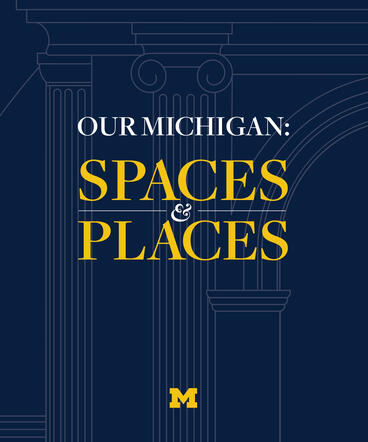
(University of Michigan Press, 2025.)
Memories fill sweet spots all over this place, from the Arb to the Union to the UgLi; from Bursley to the Residential College to the Fishbowl. The art deco flourishes at Rackham may speak to one alumnus while the corbels that animate the Law Quad captivate another. There are fountains and murals and gardens for inspiration; theaters and concert spaces and workshops for expression. Makerspaces abound across North Campus as new technologies emerge. Buildings today are home to giant lasers and telescopes and nanofabrication laboratories.
As President Grasso says, “Buildings and landscapes announce a university’s presence and potential. But it is how people experience those spaces and places that transforms lives.”
Ironically — or not — one structure notably absent from the narrative is a certain nondescript, two-story building with cinder block walls and clanging steam pipes.
But that’s OK. In a chaotic world where change is constant — and terrible news of the week can literally rock the campus you’ve come to know and love — there’s something stabilizing about that ’70s-era drinking fountain in the Michigan News hallway; it could well be the same machine that slaked your thirst in elementary school.
With each celebration of campus development, redevelopment, and more development, there is some small comfort to be found in such rare imperviousness to change.
Full disclosure: I contributed to the Spaces & Places book, but am not part of the sales equation in any way. And while I admit it’s corny to self-promote one’s own project, the content (at 150 pages) delivers some colorful historical background (courtesy of Michigan Today’s Jim Tobin), quirky trivia, and lots of rarely seen photos that bring to life a long-gone campus.
I’m just glad my cinder block paradise did not score a space on the book’s two-page demolition spread, a study in sepia-toned destruction, which turned out to be one of the most eye-catching sequences in the whole undertaking.
(Note: A limited quantity of books is available internally for staff marketing and other related needs.)


David Schmueser - 1973 (BSE), 1974 (MSE), 1979 (PhD, ME)
Deborah,
Really enjoy your fantastic editorials that come out of your cinder block paradise. Keep up the great work!
David Schmueser
Reply
Jim Stoetzer
My seven years on the University of Michigan campus will never be forgotten. I look forward to perusing the pages of this new tome no doubt reinforcing and extending those memories. Thank you.
Reply
Chris Campbell - Rackham '72;Law '75
I spent 4-1/2 years on the campus. As you note, what happens there is what really matters, but where it happens can affect the experience. I spent lots of time in the original UGLI, the Hatcher library, and then the glorious law quad.I walked among the various Albert Kahn buildings and occasionally visited the Rackham building. There were moments in Hill Auditorium. Those years were a difficult time in my life, but it helped to be learning and growing in cool places.
Reply