Statement before the Committee on Education & the Workforce
March 26, 2026
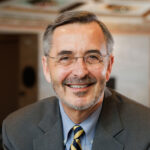
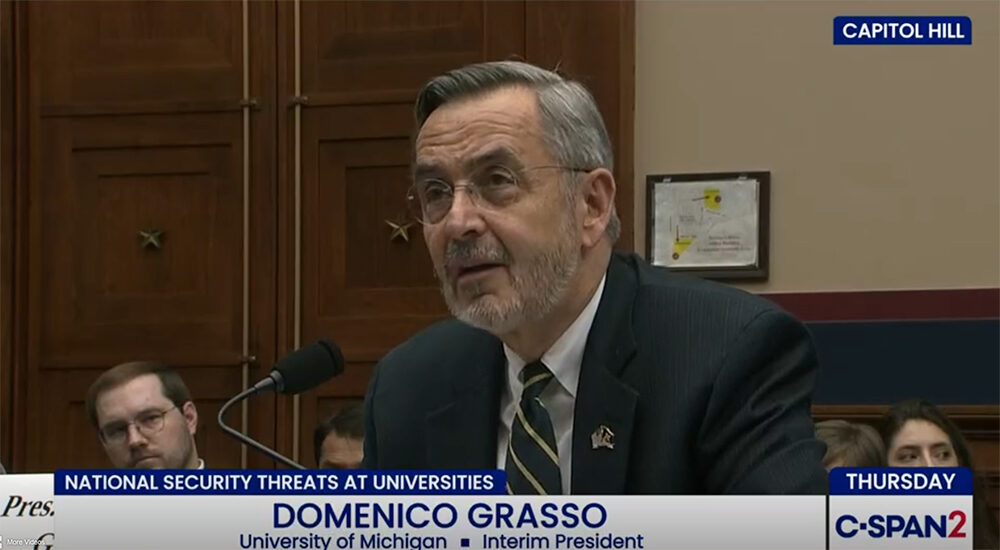
The following is a transcript of the opening statement by U-M President Domenico Grasso when he spoke to the U.S. Committee on Education & the Workforce in Washington, D.C.
Research security
Chairman Walberg, Ranking Member Scott, and members of the committee, thank you for the opportunity to speak with you today about research security at the University of Michigan.
My name is Domenico Grasso, and I have had the privilege and honor of serving as the president of the University of Michigan since May 2025. My term will end this May. As an engineer and an Army veteran who currently holds a Top Secret security clearance, I am deeply committed to protecting our nation’s security and ensuring that the University continues to support the research, talent, and partnerships that help make Michigan special.
The University of Michigan is one of the nation’s largest and most prominent research universities. It comprises three campuses and nearly 75,000 undergraduate and graduate students and 60,000 faculty and staff. We have more than 110 programs ranked in the top 10 across the nation. With a $16-billion budget, the University engages in a broad range of activities driving our mission of academic excellence, innovation, and public service.
Public engagement
The University is involved in a remarkable array of newsworthy activities. To give you a sense of the scale and national scope, not including sports news, last year the University of Michigan was covered nearly 600 times in just The New York Times and Wall Street Journal. There is a lot to follow.The University is a world leader in scientific and technological advancement. In 2025 alone, Michigan researchers developed more than 600 new inventions, launched 30 new startups, and received more than 1,600 research awards. Our research community has achieved meaningful breakthroughs in a number of critically important fields. I would like to share just a few examples of our groundbreaking medical research.
- The University of Michigan’s School of Public Health developed FluMist, a nasal-spray influenza vaccine that expanded access to immunizations — particularly for children — by eliminating the need for injections and helping protect tens of millions of people from seasonal flu.
- Our University’s clinicians and engineers also pioneered advances in extracorporeal membrane oxygenation, or “ECMO,” creating heart-and-lung support for patients experiencing severe respiratory or cardiac failure. This work has saved tens of thousands of lives worldwide, including the most fragile pediatric patients.
- And Michigan Medicine developed a bioartificial kidney designed to treat acute kidney failure and sepsis, helping filter toxins and modulate the immune response to address a leading cause of mortality in critically ill children.
The list goes on. We developed a revolutionary treatment for myeloid leukemia and other cancers, created tools to prevent children from online abuse, and are finding new ways to prevent and alleviate poverty through action-based research.
Strengthening national security
These remarkable achievements highlight the University of Michigan’s unwavering commitment to advancing medical science and improving lives around the world. They are made possible by Michigan’s ability to attract the best and brightest from every corner of the United States and the world. This talent drives research that advances American competitiveness while directly strengthening our national security.
One example of the University’s advanced research capabilities — and one close to my heart as an engineer and a former Army officer — is our work toward keeping our country and the world safe from nuclear proliferation. University of Michigan researchers have developed the first-ever imager that can detect both gamma rays and neutrons, an astonishing breakthrough in our nation’s ability to detect material capable of producing nuclear weapons. Another example can be found in our Automotive Research Center. There, University researchers develop technologies for autonomous off-road vehicles that keep members of our armed forces out of harm’s way by carrying out high-risk missions autonomously.
The University of Michigan’s long history of advancing America’s national security includes the development of nearly 200 classified wartime projects during World War II; the design and construction of next-generation fission and fusion reactors that strengthen American energy independence; and the creation of the virtually unhackable Morpheus computer chip; and so much more.
Commitment to research integrity
Housing some of the world’s greatest minds makes the University of Michigan a potential target of threats such as research espionage, unauthorized technology transfer, and foreign talent recruitment programs. That is why the University has established a comprehensive program to safeguard our research from America’s adversaries.We share this committee’s commitment to research integrity and have no tolerance for behavior that may risk the security of our nation. In isolated but serious incidents, a small number of University students and researchers from China have been arrested for unlawful activities. In each case, the individuals carried out their unlawful acts without the University’s knowledge. Once alerted, we acted swiftly and decisively — working with federal law enforcement, promptly terminating student and work visas, and severing all ties with those individuals.
The University has a comprehensive research security and compliance program, which includes risk management for international collaborations, mandatory training, and data security protocols to ensure safe and secure research. And we are meeting the increased threat with increased security. We are setting university-wide standards for visiting researchers and expanding use of background checks. We are enhancing oversight of biological material entering or leaving University labs and strengthening physical security. And we are working to open more regular lines of communication with federal regulatory, law enforcement, and intelligence agencies.
Safety and security is a team effort and, at Michigan, we know how important it is to be a team player. We stand committed to protecting the interests and security of the United States. This commitment is illustrated by our decision to end a relationship with a university in China that is seen as a potential threat to America’s interests. We made this decision after discussions with this committee and the House Select Committee on the CCP.
We have a special bond with this committee as three of our close Michigan friends and neighbors, Chairman Walberg and Congresswomen McClain and Stevens, serve on it. We look forward to continuing our dialogue with this committee to ensure that the interests of Michigan — and of the nation — are protected from both the known threats we face today and those that may emerge in the future.
I look forward to our conversation.
Domenico Grasso, PhD
President