
Environment
-

Recipe for a global crisis
The war in Ukraine, coupled with COVID-19 and climate change, is the latest in a string of dramatic shocks to global food production. At the World Business Council for Sustainable Development (WBCSD), Amy Senter, BS ’08/MS ’11, mobilizes efforts to address these formidable challenges.
-

Tusk reveals clues about extinct species
Some 13,000 years ago, a roving male mastodon died in a bloody mating-season battle in what today is northeast Indiana, according to the first study to document the annual migration of an individual animal from an extinct species.
-
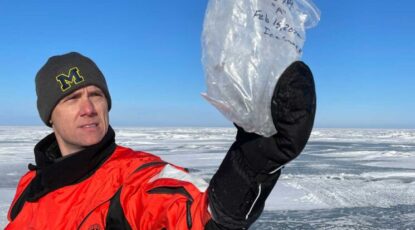
Winter grab: Boring through Saginaw Bay
U-M biogeochemist Casey Godwin examines this chunk of crystal-clear ice as if it were a priceless gemstone pulled from the earth. The ice is, in fact, precious, offering a rare glimpse of life below the Great Lakes.
-

Winter Grab: Dozens of Great Lakes scientists study ‘the changing face of winter’
Scientists from more than a dozen U.S. and Canadian institutions are braving the elements to sample all five Great Lakes and Lake St. Clair in a first-of-its-kind coordinated campaign called the Winter Grab.
-

Detroit River narratives emerge through schooner trips, boat building
U-M’s Detroit River Story Lab partners with community groups in Flint and Detroit to teach schoolchildren about ship construction and buoyancy, river ecology, and the river’s role in the history of the Underground Railroad.
-

Water affordability crisis looms
Water and sewer service affordability, at both household and community levels, is a widespread problem across Michigan. A new study warns it may get worse if left unchecked.
-

U-M combats residential flooding in Detroit
The city’s aging infrastructure is no match for the severe effects of climate change. But with $1 million from the Kresge Foundation, U-M’s School for Environment and Sustainability will work with local partners to mitigate flooding and other concerns.
-
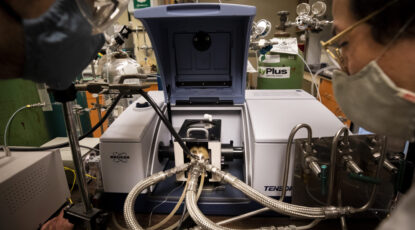
$2M to replace fossil fuels with solar power in fertilizer production
U-M researchers will study the effectiveness of a new ammonia production process aimed at reducing greenhouse gas emissions. Bringing the process directly to farmers could cut environmental costs by reducing transportation requirements.
-
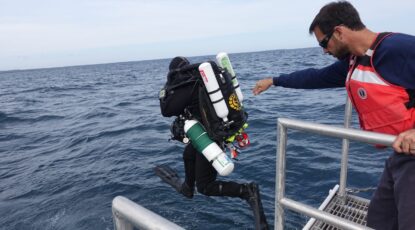
Lake Huron sinkhole surprise
Researchers propose that increasing day length on the early Earth may have boosted the amount of oxygen released by photosynthetic cyanobacteria, changing the planetary rotation rate.
