

Climate strategy and national security
In the year 2000, I was the lead author of a report on climate modeling and high-performance computing (Rood et al. 2001). One motivation for writing that report came from a concern that the U.S. was spending, relative to other countries, a large amount of money on climate modeling but not getting what it needed. In particular, this was the time of the first National Climate Assessment, and no U.S. model was in the position to supply the needed products. We used Canadian and United Kingdom models.
The inability of U.S. models to provide the needed simulations was unacceptable to Congress for a number of reasons. They included the fact that climate change was of strategic importance to the nation and, as such, we needed to supply our own simulations. We needed to have expert knowledge and state-of-the-art tools. Though the models from other countries were state-of-the-art, it was not in our best interests to rely on products from other countries. They may not address the priorities and purposes that are most important to the U.S. There was no guarantee of availability.The 2001 report contributed to the implementation by the George W. Bush administration of the “two-center policy,” in which two of our existing modeling centers would assure that validated simulations were available for U.S. interests. These centers were the National Center for Atmospheric Research and the Geophysical Fluid Dynamics Laboratory.
Some two decades later, federal policy is willfully shifting into reverse and driving the U.S. back to the year 2000 toward a state of ignorance.
Human welfare in a changing climate
A screen shot from the home page of the National Center for Atmospheric Research website.
In about 2004, my friend Tony Hollingsworth, at the European Center for Medium-range Weather Forecasts, sent me a document on environmental security. This forward-looking document encompassed global warming as well as air quality, water resources, ecosystems, etc. Tony’s premise was that human welfare relied on our relationship with the environment, which was changing. We needed predictive skill and exploratory research to contribute to a secure and stable relationship.
Tony asked me to shop the report around the U.S. agencies. He felt that having two major efforts in environmental security would make each better. Plus, he thought if the U.S. and the European Union (E.U.) viewed the other as gaining advantage, funding would be assured. My power and influence were not what he hoped, and I got no takers on environmental security as a focus. I felt that was a moment when the E.U. started to move ahead on all aspects of environmental simulation and its practical applications.
Environmental security
I liked and still like the environmental security framing. It is concrete and meaningful. If we had a National Environmental Security Council in the U.S., such an organization could be a “customer” of the science agencies. This would help to break the structural flaw in which the science agencies have to argue why the research is relevant, argue for the resources to perform the research, do the research, and then, prove it was relevant because someone else is using it. If there was a clear understanding that environmental knowledge was fundamental to creating a secure and stable society, this cycle of confused interests could be improved.
Rosina Bierbaum and I even wrote a short White Paper advocating for such an organization in 2020. As in my efforts in 2004, it got no traction in what might be viewed as the best of times.
Getting personal
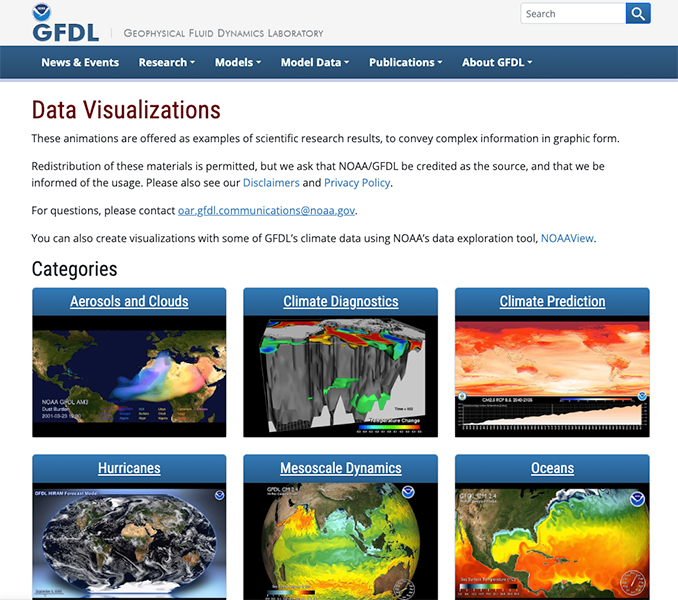
A screen shot from the Data Visualization page of the Geophysical Fluid Dynamic Laboratory.
Environmental security is not an especially well-defined term. But it can be found in documents by the U.S. State Department, the Department of Defense, and the Central Intelligence Agency for decades. In many cases the definition is narrowed to how environmental issues influence national security, energy security, economic security, and health security. This, in fact, is consistent with an earlier Climate Blue column on how it is difficult to maintain focus on climate change. We do not consider the environment important enough to stand by itself.
At times, we have had climate scientists advising the National Security Council with the purpose of providing knowledge on how climate change influences national security. And while these global and national issues are important, I think of environmental security on a more personal and local level. We feel climate through the weather and landscape, and our relationship with the weather is changing as the climate warms
How are we going to deal with sea-level rise in the next five years — the next 50 or 100 years — not to mention floods, droughts, fire, and heat?
I do not think that people appreciate how much we are tuned into our climate and weather. One of the most obvious ways is in agriculture, through our production of food. Another is through zoning laws and building codes that are informed by weather and climate. We are attuned to specific and longstanding seasonal cycles of water and heat. We are adapted to a range of highs and lows.
Lessons from the last Ice Age
A paper that caught my interest many years ago addressed how commerce and civilization took off as sea level stabilized after the last Ice Age.
I have thought a lot about humans at the end of the last Ice Age.
Their climate was warming. Water resources were changing. In some places, deserts were emerging. As a collective, people adapted. But they did not understand what was happening. They did not know what to expect.The disruptions we are experiencing today are telling us that our more-or-less safe relationship with the weather and water is changing. But unlike our predecessors in the ice age, we do have the knowledge to understand what is happening. We have the ability to inform what to expect.
We can think about using this knowledge on a personal level. Or we can think about using this knowledge on a more strategic level that is relevant to our economic wellbeing and security. Our competitors who are generating and using such knowledge have already claimed the advantage.
Backsliding through the decades
The organizations that comprise the two-center policy — the National Center of Atmospheric Research and the Geophysical Fluid Dynamics Laboratory — have each been targeted by the Executive Branch. They have been described as sources of (unnecessary) climate anxiety.
The climate science capacity that we have built since 2000 is being diminished. We are, in all official federal governmental ways, withdrawing from the international climate community.
We are deliberately going back to that situation in the year 2000 when we were dependent on models and science from other countries.
Addressing the absurd
There will be a day when we realize we have made a consequential, strategic mistake.
The repercussions will arrive from all directions.
For example, in the realm of geopolitical consequences, there are the national, energy, economic, and health security issues born of the melting Arctic. Population displacement and migration will increase as people face drought, fire, and flood.
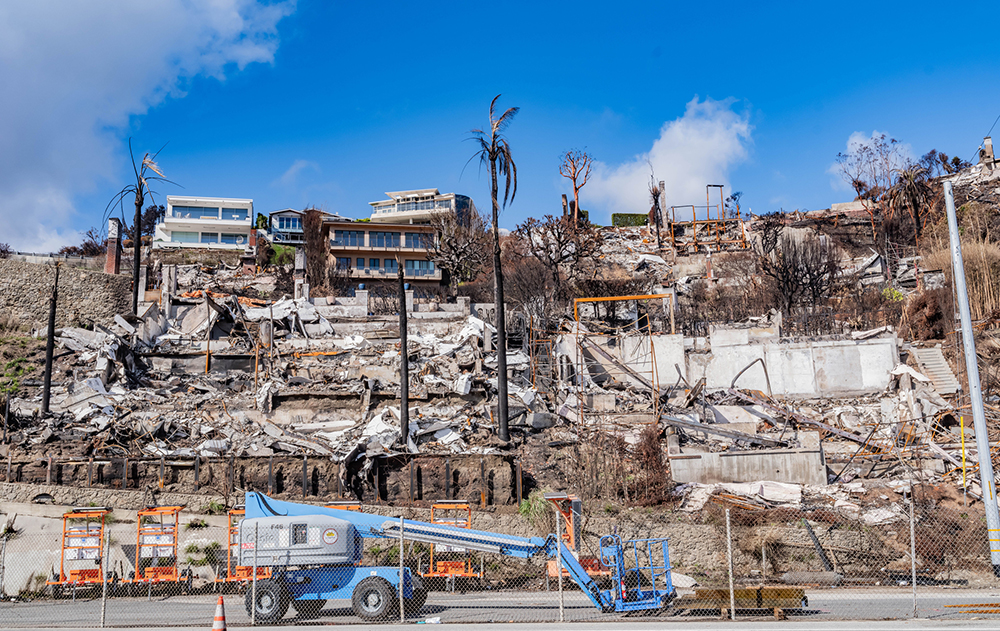
Destruction along the Malibu coastline after wildfires raged out of control through residential areas in Southern California in early 2025. (Image iStock.)
In the U.S., there are similar issues as we think about transforming agriculture, managing our coastlines, and fighting fire at the wildland-urban interface. We face questions about where to build, where to invest, and how to protect our businesses. If nothing else, we must ask: What are we going to do about increasing insurance rates?
We are in an absurdist world where our government admits that we are warming, but can’t (or won’t?) explain why.
Meanwhile, we have a body of evidence-based knowledge that explains what is happening with more than 99% confidence.
That evidence offers us an imperfect but informed vision of the future. This benefit of scientific foresight is unique to our time in history. Unlike the Phoenicians building ports and economies without such knowledge, we know that our ports and coastal cities are in for profound changes in the coming decades.
But this body of knowledge is considered heresy by the current government.
Our leaders have chosen to drive blind and deal with things as they occur. They see little value in understanding what is happening or examining the consequences of certain choices. As a nation, we are only making things harder for ourselves, increasing our insecurity.
There are two ways we can approach our recalibration with weather and climate. We can react and, likely, enter into a progression of poorly informed, crisis-driven decisions, which are not durable. The alternative is to use science-based knowledge to anticipate what is coming. Using this method, anchored in observations and simulations, we can develop plausible and likely paths. We can describe the changes in the characteristics of storms, droughts, and floods.
When we get to the point that we regret the diminishment of our climate-science capabilities and start the recovery toward rebuilding to full capacity, environmental security should be at the forefront of our purposes.


andrew sofen - 1974, 1978
intelligent, and reasonable examination of our current interest in climate change, and our cavalier public attitude toward the ramifications of disinterest
Reply
Jonathan Blanton - 1975
The statement that “we have a body of evidence-based knowledge that explains what is happening with more than 99% confidence” is laughably absurd. The establishment of another massive layer of bureaucracy in the form of a “National Environmental Security Council” would unnecessarily enlarge the already grossly bloated and inefficient and recklessly expensive federal science bureaucracy, simply for the fundamental purpose of enforcing the party line on “climate change” and maintaining the flow of funds in support of the political and economic power agenda of those “activists”.
Reply
Eric Stine - 2004
Well said. Somehow criticism of the past decade of alarmist activism and its ties to funding political groups is never covered by the University
Reply
Adam Davis - 2010
I would counter that your description of the explanatory power of climate science as laughably absurd is itself laughably absurd. Your inclusion of quotation marks around “climate change” is also telling. Even if you somehow don’t believe that human activity is markedly affecting the Earth system, it is clear that the planet’s climate has changed over time and will continue to do so. Suggesting otherwise is simply denying reality.
Reply
Thomas Cislo - 1972, 1975
Excellent analysis and insight Mr. Rood. May science-based thinking and risk management prevail in the long run. Each of us must do what we can to keep this issue paramount.
Reply