
A lot to cheer about
Student-athletes are a rare species unto themselves. Not only are they elite competitors, they have to perform in the classroom, represent the University beyond Ann Arbor, manage heartbreaking loss in the glare of the spotlight, and demonstrate unfathomable humility when the coveted championship title comes home.
Now they have new challenges to navigate — for better or worse — thanks to updated rules regarding the NCAA transfer portal and new financial opportunities that allow them to profit off their name, image, and likeness (NIL).
As fans, we expect so much of these disciplined young adults, pinning our hopes for glory on their shoulders, often forgetting how inexperienced they are when it comes to the big picture, writ large. U-M does its best to support the mental health of student-athletes, providing skills to deal with their own self-imposed expectations as well as the external feedback from obnoxious “fans” who harass them when such expectations aren’t met.
These past few months have given Michigan fans a lot to cheer about: a women’s basketball team that made it to the Elite Eight in the NCAA national championship, a men’s hockey team competing through the Frozen Four, and of course, a men’s basketball team that earlier this week snagged its first NCAA national title since 1989.
Imagine the obstacles these players had to navigate —physically, emotionally, academically — so we could have a good time watching them compete.
Do unto others
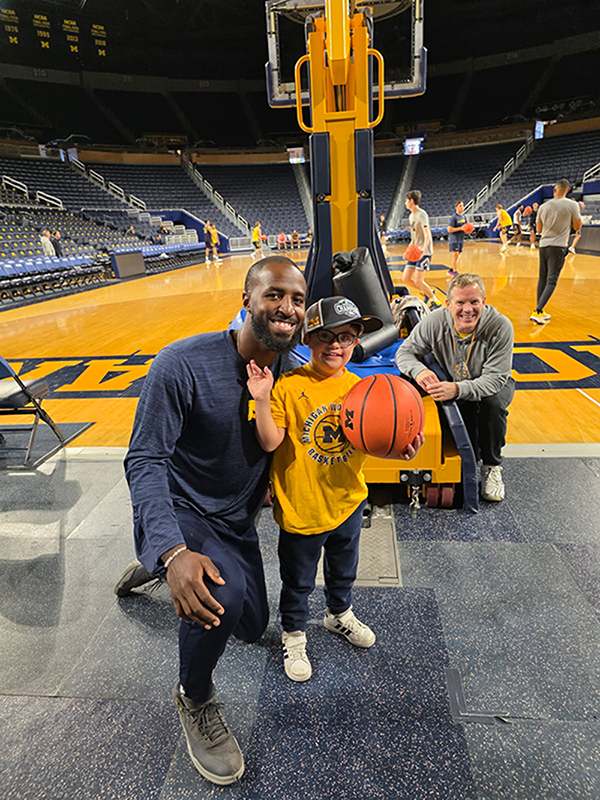
Young Michigan basketball fan Greyson contributed to the success of the 2026 NCAA champions with his infectious enthusiasm and love of the game. (Image: Team IMPACT.)
Common wisdom shows one of the best ways to deal with mental health stressors is to support others. And one of the season’s highlights for me is seeing the players do just that by interacting with their young fans, often through nonprofits like Team IMPACT, which matches special-needs children and young adults with their favorite local teams.
This season, a 9-year-old Michigan boy named Greyson served as the “secret weapon” for the men’s basketball team, inspiring the athletes with his own brand of infectious enthusiasm. He attended practices, traveled to games, and formed a close bond with Head Coach Dusty May and his players.
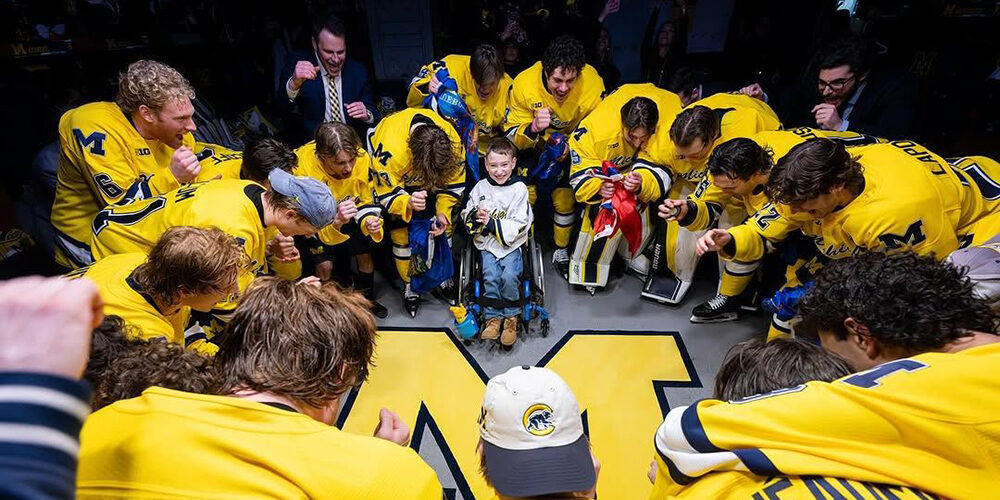
An 11-year-old named Conner (featured above), who lives with complex medical needs, was matched to the hockey team. From joining in locker room rituals to sharing his sled hockey skills, Conner’s confidence flourished through his bond with the team. He also showed up for his teammates, celebrating their milestones and supporting them through tough moments. And few are tougher than dropping a 4-3 heartbreaker in double overtime to third-ranked and second-seeded Denver at the 2026 Frozen Four semifinals on April 9.
Last year, we ran a feature on a young woman named Sunny, who brought her signature optimism to the women’s basketball team in much the same way. With her ever-positive attitude, Sunny showed the team that loving basketball goes beyond playing the game. Never failing to give hugs when the team was down and offering high fives after exhilarating wins, Sunny stayed by the team through thick and thin. She became a role model for them, delivering lessons on perseverance, diligence, teamwork, and companionship.
Who can measure the profound and enduring impact such interactions can produce?
Victors valiant
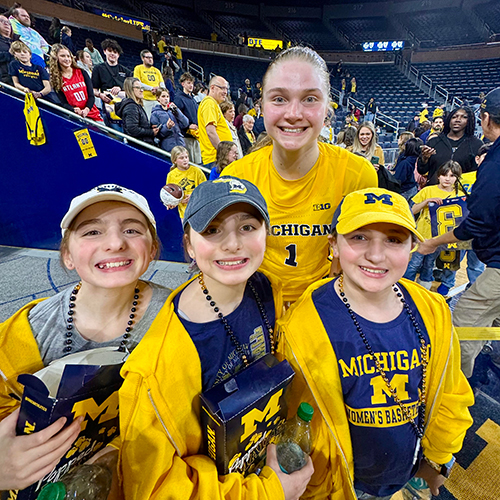
The Buursma triplets met Wolverine Olivia Olson during a break in the action against MSU. (Image courtesy of Victoria Buursma-Litzner.)
We’ve seen the sweet ways the athletes cheer up the pediatric patients at C.S. Mott Children’s Hospital (Bryce Underwood looks absolutely super in a Batman costume, btw). And sometimes it’s just a spontaneous and kind interaction among players and young fans in the crowd that reminds us of the life-changing power of college sports. When female student-athletes meet a family of triplets dressed head to toe in maize and blue on the Crisler sidelines, they gain new perspective of their own power as leaders and mentors. (Plus, it makes for a really fun photo.)
Meanwhile, the spirited hopefuls — in this case the Buursma triplets — may see their future selves amid infinite possibilities. “At their age, they’re just starting to figure out who they are and what they might want to be, so seeing athletes makes those dreams feel real and within reach,” says their mother, Victoria Buursma-Litzner. “Watching them light up and begin to picture themselves in those same spaces, on a team, on a college campus someday — it means everything.”
In competitive college sports, trophies are intensely coveted prizes, and winning is seen as the primary goal. But these young fans, whose hearts are firmly in the right place, continue to teach the Wolverines (every one of us) that teams can be flush with victory in so many beautiful ways.
(Lead image: This season, the Michigan hockey team was buoyed to the Frozen Four by their young fan Conner. Image courtesy of Team IMPACT.)


Kathy Burton - 1972
News about such connections are so welcomed today and form images to treasure each day of our lives. Thank you DH, heart to heart!
Reply
Deborah Holdship
Glad you liked it, Kathy. I am with you, heart to heart, for sure!
Reply