
Research News
-

Insect cyborgs may become first responders, search and monitor hazardous environs
A fascinating new invention could make it possible to use living insects, equipped with tiny battery packs and electronics, to enter hazardous environments and send back data and even video safely to first responders.
-
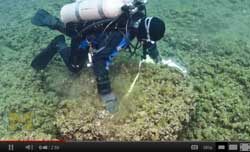
U-M divers retrieve prehistoric wood from Lake Huron
Under the cold clear waters of Lake Huron, U-M researchers have found a five-and-a-half foot-long, pole-shaped piece of wood that is 8,900 years old. It seems to have been carved by humans, and carried across a land bridge that no longer exists. The simple object may provide clues to long-enduring mysteries about Great Lakes history.
-
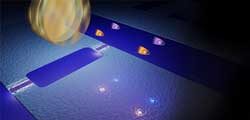
Physicists' 'light from darkness' breakthrough named a top 2011 discovery
The physicists directly observed, for the first time, light particles that flicker in and out of existence in the vacuum of space. They witnessed the long-predicted quantum mechanical phenomenon known as the dynamical Casimir effect. “One of the profound consequences of quantum mechanics is that we know that something can come from nothing,” said U-M’s Franco Nori.
-
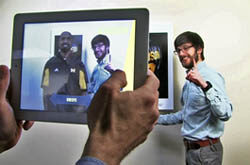
3-D Woodson!
It’s said that water covers 70% of the earth, and former U-M cornerback Charles Woodson covers the rest. Now Woodson’s presence is even stronger in the halls of U-M’s Mott Children’s Hospital: he can appear on your iPad or iPhone in 3-D when you point it at a special jersey hanging on the wall.
-

Generation X: U-M survey paints positive portrait
Study: They’ve been stereotyped as a bunch of insecure, angst-ridden, underachievers. But most members of Generation X are leading active, balanced, and happy lives.
-

Michigan, the moon, and beyond
From even before the all-Wolverine crew of Apollo 15, the U-M College of Engineering has played a key role in American space flight.
-

Ancient whale skulls and directional hearing: A twisted tale
Skewed skulls may have helped early whales discriminate the direction of sounds in water and are not solely, as previously thought, a later adaptation related to echolocation.
-

Looking for life on Mars
“On Earth, everywhere there’s liquid water, there is microbial life,” says U-M professor Nilton Renno. He’s the scientist who discovered liquid water droplets on Mars, and he’s now leading a project to explore pockets of very salty, liquid water on the red planet. It might be the best bet for finding microbial life beyond Earth.